Ramat Beith Shemesh Dalet | Anglo Community
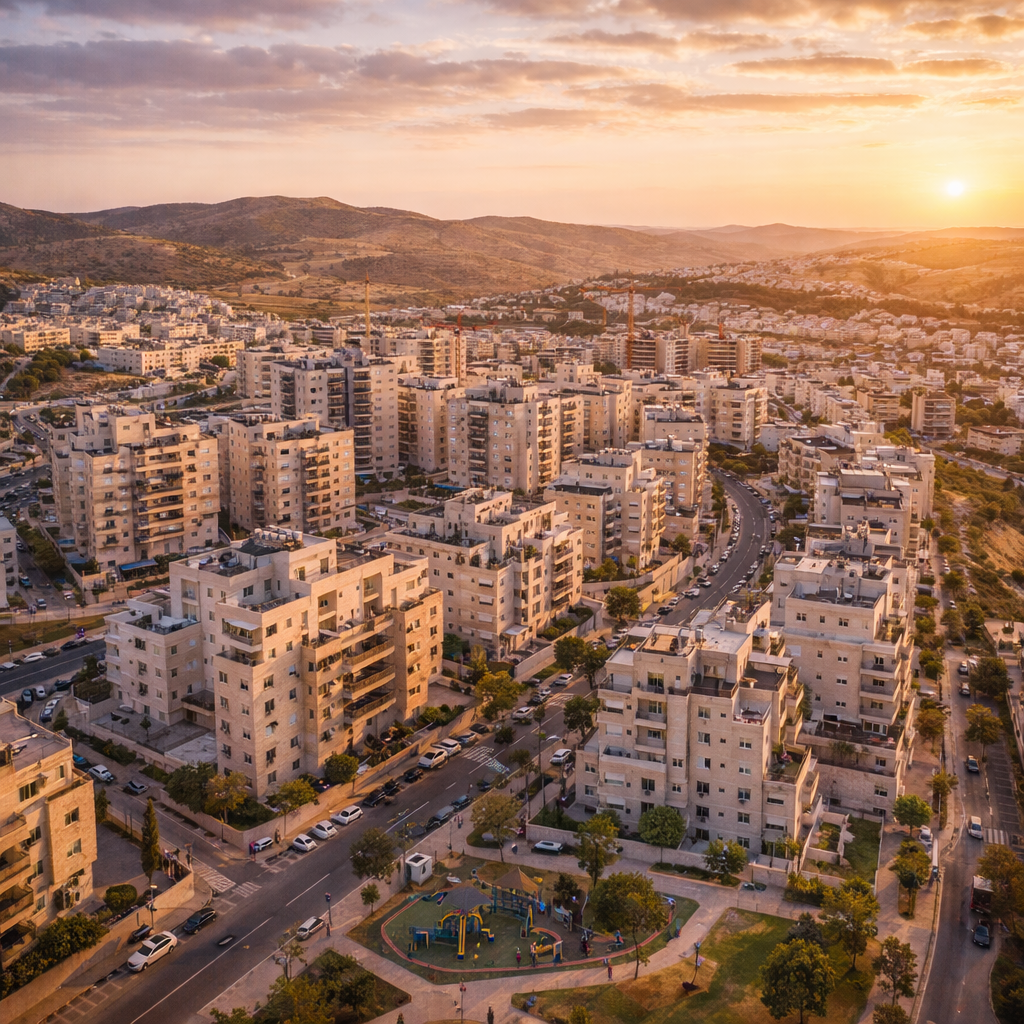
To understand Ramat Beit Shemesh Dalet, you need to stand at the southwestern edge of the city and look out toward the horizon. Beyond the established neighborhoods of Ramat Beit Shemesh Aleph and Gimmel, past the valleys and hills that have defined this landscape for millennia, a massive construction project is taking shape. This is Ramat Beit Shemesh Dalet, the newest and most ambitious neighborhood development in one of Israel’s fastest-growing cities, a sprawling ultra-Orthodox community that, when completed, will be home to tens of thousands of families and will fundamentally reshape the demographics and character of Beit Shemesh for generations to come.
The story of Ramat Beit Shemesh Dalet begins with a deliberate planning decision made by the Ministry of Construction and Housing in response to the sensitive and sometimes contentious relations between the ultra-Orthodox and non-ultra-Orthodox populations in Beit Shemesh. After years of demographic shifts that saw the city become increasingly Haredi, with tensions occasionally erupting between different groups, the authorities decided to pursue a policy of intentional separation in the newest neighborhoods. In 2016, the Israeli Land Authority published tenders for thousands of new apartments in two massive developments: Ramat Beit Shemesh Dalet and Ramat Beit Shemesh Hey. The distinction was clear from the outset: Dalet would be marketed specifically for the ultra-Orthodox community, while Hey, which became known as Neve Shamir, would be designated for the national religious and secular populations.
This was not merely a marketing strategy but a comprehensive planning approach. Ramat Beit Shemesh Dalet was designed from the ground up specifically for religious families, with careful attention to their unique needs. The neighborhood would feature synagogues, mikvehs, and various educational and religious institutions integrated into the urban fabric from the beginning. Unlike some developments where religious infrastructure is added as an afterthought, Dalet was conceived as a thoroughly Haredi neighborhood, a place where families could live in an environment tailored to an ultra-Orthodox lifestyle without compromise or adaptation.
The scope of Ramat Beit Shemesh Dalet is extraordinary. The neighborhood is located in the southwestern part of Beit Shemesh, bordering the existing neighborhood of Ramat Beit Shemesh Gimmel. To its west is Road 38, one of the major arteries connecting the region, and to the south lies the Ella Valley with Nachal Yarmut and Beit Jamal to the north. The neighborhood will eventually cover approximately six thousand acres and spread across multiple districts. As of 2024, there are four sections currently designated: RBS Daled 1, 2, 3, and 4, though different sources cite varying numbers for the total planned apartments. Some reports indicate that eight thousand homes and apartments will be built across Daled 1, 2, and 3, with Daled 1 and Daled 2 each comprising three thousand apartments and Daled 3 having two thousand. Other sources suggest that the total number of planned apartments could reach fifteen thousand across all four sections, making it one of the largest single neighborhood developments in the country. The most recent assessments indicate that ultimately there will be eighty-three hundred new apartments in RBS Dalet alone.
Development began in earnest in 2019, with infrastructure work including roads, utilities, and the basic framework for what would become a city within a city. While there is still a significant amount of construction ongoing, many buildings have already been built and populated, predominantly by Haredi Jews. The neighborhood overlooks the Nachal Yarmut Park, offering residents beautiful natural vistas alongside their urban development. The area is built on hills, and like much of Ramat Beit Shemesh, it features many steps, shortcuts, and paths connecting different areas, along with landscapes, parks, and greenery designed to give children safe spaces to play and families places to gather.
The relationship between Ramat Beit Shemesh Dalet and the older neighborhood of Ramat Beit Shemesh Aleph is often compared to the relationship between Boro Park and Flatbush in Brooklyn, or between Lakewood and Toms River in New Jersey. Dalet is close enough to Aleph that residents have all their amenities at their doorstep, able to access the established shopping centers, schools, and services of the more mature neighborhood, yet it maintains its own distinct identity and character. This proximity is crucial for new residents, particularly those making aliyah, who need the support infrastructure that comes with an established community.
The transportation planning for Ramat Beit Shemesh Dalet has been carefully considered. Easy access has been designed via the new and expanded Road 38, Road 10, and the new Road 5, ensuring that despite the neighborhood’s size and somewhat peripheral location, residents can commute to Jerusalem, Tel Aviv, and other employment centers. This is particularly important because while the Haredi community has historically had a high percentage of men learning in kollel rather than working, there’s an increasing recognition that economic participation is essential for family sustainability, and many Dalet residents do commute to jobs.
One of the most significant aspects of Ramat Beit Shemesh Dalet is its pricing structure. A substantial percentage of the apartments, estimated at sixty percent in some sections, are being sold under the Mechir Lemishtaken program, the government initiative that offers discounted apartments to Israeli citizens who have never owned a home before and meet certain requirements. This program has been instrumental in making the neighborhood accessible to young Haredi families who might otherwise struggle to afford housing in Israel’s expensive real estate market. The availability of affordable housing through this program has attracted both couples just starting out and families relocating from more expensive areas like Jerusalem or Bnei Brak.
The Anglo community in Ramat Beit Shemesh Daled is growing but represents a smaller percentage than in neighborhoods like Aleph or Gimmel. That said, there is a definite Anglo presence, and institutions are being built to serve this population. Most notably, the Anglo community received a plot of land from the municipality and recently used it to build a synagogue. The community is called Kehillas Bnei Aliyah, and it serves as a focal point for English-speaking families in the neighborhood. Beyond this, there are many shuls scattered throughout Dalet, representing a mix of Hasidic and Litvish communities, reflecting the diversity within the ultra-Orthodox world.
Two particularly significant Anglo institutions are in the process of being established or have recently opened in Ramat Beit Shemesh Dalet. Kollel Ohr HaShemesh, founded and led by Rabbi Yerachmiel D. Fried, is being established specifically to serve as the beating heart of the growing Anglo Torah community in Dalet 4. Rabbi Fried, who spent over three decades building Torah infrastructure in Dallas, Texas, has relocated to Israel to create what he envisions as a transformative institution. According to the kollel’s materials, there is no English-speaking kollel in Ramat Beit Shemesh Dalet 4, and the neighborhood is being built from the ground up with families coming who face language barriers and the disconnection that can come with aliyah. Kollel Ohr HaShemesh aims to offer a spiritual anchor, a place where Anglo families can find guidance, connection, and community in their native language.
The kollel has received endorsements from multiple rabbinic authorities. Rabbi Eliezer Spetner, who serves as Mara D’asra in RBS-D, has stated that the neighborhood is home to many American avreichim who are in need of an authentic makom Torah and that Rabbi Fried will establish such a place. Support has poured in from sources ranging from the Mayor of Beit Shemesh to Nefesh B’Nefesh, from rabbanim across America to leaders in Israel. The vision is to create not just a place of learning but a community center that will offer shiurim, learning programs, and pastoral guidance to families navigating the challenges of building lives in a new country.
Similarly, Achsanya Shel Torah has established a fledgling kehilla in Beit Shemesh Ramat Dalet 2 on Mar Ukva Street. Since its inception in September 2023, this community has focused on bringing together like-minded families who see their future as perpetuating Mesoras Ashkenaz in Israel. The kehilla boasts full Shabbos minyanim as well as Shabbos and night-seder kollelim. This represents an important niche within the Haredi world, as many Anglo families come from Ashkenazi traditions that differ somewhat from the Israeli Haredi mainstream, and having a community that explicitly maintains those traditions provides an important sense of continuity and identity.
Educational infrastructure in Ramat Beit Shemesh Dalet is developing rapidly. Many schools are being opened in the neighborhood to serve the growing population. For younger children, Magen Avos, the American-style Haredi school based in Ramat Beit Shemesh Aleph, has established preschools in Dalet on Rava Street, including Gan Dasi for three and four year olds and Gan Shelly for five year olds. The school provides transportation for students from Dalet to the main campus in Aleph, ensuring that families in the newer neighborhood can access the educational options available in the more established area.
The neighborhood is also close to the schools in Ramat Beit Shemesh Aleph, which means that even as local schools are being built, families have options. This proximity to established educational infrastructure was a key consideration in the planning of Dalet, recognizing that institutions take time to develop but families need educational options immediately. Over time, as the population grows, the neighborhood will develop its full complement of schools representing the various Haredi streams, from Litvish yeshivos to Hasidic chadorim, from Bais Yaakov schools to more specialized institutions.
One particularly interesting halachic question arose in Ramat Beit Shemesh Dalet that illustrates both the neighborhood’s development and the serious Torah scholarship of its residents. After new buildings were added to Ramat Beit Shemesh Dalet that connect to the neighborhood of Chorvat Tel Yarmot, a controversy arose over when to read the Megillah on Purim. According to archaeologists, the latter area is potentially a walled city from the days of Yehoshua bin Nun, which would mean that Purim should be celebrated on the fifteenth of Adar rather than the fourteenth. This sparked a halachic storm in the Torah world, with different rabbinic authorities weighing in. Ultimately, Rabbi Moshe Shternbuch, the Raavad of the Eidah Hachareidis, issued an unequivocal ruling that Purim in Ramat Beit Shemesh Dalet is on the fourteenth and not the fifteenth. This kind of serious halachic engagement demonstrates the level of Torah scholarship present in the community and the care with which residents approach religious observance.
The commercial development in Ramat Beit Shemesh Dalet is still in its early stages but advancing. The neighborhood is designed to include advanced commercial centers that will serve residents’ daily needs without requiring them to travel to other neighborhoods. Plans include shopping centers with supermarkets, banks, clinics, and various stores. The extensive parks being built will incorporate bicycle paths and safe walkways for pedestrians, creating a family-friendly environment where children can play safely and families can enjoy outdoor recreation without leaving the neighborhood.
The real estate market in Ramat Beit Shemesh Dalet has shown robust growth. According to market reports from early 2025, Ramat Beit Shemesh Dalet attracted both domestic and international buyers drawn by newer housing stock and enhanced infrastructure. In predominantly Haredi neighborhoods like Dalet, prices rose by over eleven percent in the first quarter of 2025, fueled by growing family sizes and the need for larger homes near synagogues, religious schools, and communal facilities. The average residential property price in Beit Shemesh as a whole climbed to approximately two million one hundred ten thousand shekels, with homes moving quickly and the average time on market dropping to just under sixty days.
Projects in Dalet have been marketed heavily to the Anglo community. The Wolfson Group, which built the successful Green Avenue project in Gimmel 2, also developed Green Hills in Ramat Beit Shemesh Dalet 4. This project brought the same high building standards and quality finishings that characterized their Gimmel 2 development. While Green Hills has sold out, the Wolfson Group announced plans for a new project in Neve Shamir, demonstrating the ongoing appetite for high-quality construction in the area.
For many Anglo families, Ramat Beit Shemesh Dalet represents an opportunity to buy into a brand-new neighborhood at relatively affordable prices while still being part of the larger Ramat Beit Shemesh ecosystem. There are many empty apartments available for rent at reasonable prices, making it attractive for families who want to try living in the area before committing to purchasing. The neighborhood’s status as a work in progress means that residents have the opportunity to shape its character and institutions as they develop, rather than moving into a fully established community with entrenched norms and hierarchies.
The vision articulated by developers and municipal authorities for Ramat Beit Shemesh Dalet is of an advanced, innovative development that caters specifically to the needs of observant families while incorporating modern urban planning principles. The neighborhood will feature shopping centers, educational and religious centers, synagogues, mikvehs, and extensive public parks, all designed with the ultra-Orthodox lifestyle in mind. The careful planning of access roads, the integration of green spaces, and the provision for commercial development all suggest a community that aims to be not just a housing development but a complete urban environment where families can live, work, learn, and raise children.
Current residents describe a very warm frum feeling to the neighborhood. Like Gimmel 2, the area is characterized by children playing on the streets on Shabbos without concern about cars, a big mix of all kinds of frum Yidden of various affiliations, and a quieter, somewhat suburban atmosphere despite being close to all the stores and institutions that Ramat Beit Shemesh Aleph has to offer. The many landscapes, parks, and greenery beautify the area while giving children space to release their energy in creative and safe settings.
The future of Ramat Beit Shemesh Dalet is closely tied to broader demographic trends in Israel. Ramat Beit Shemesh is already considered the third largest and most important ultra-Orthodox residential center after Jerusalem and Bnei Brak. The ultra-Orthodox population of Beit Shemesh has reached over fifty percent of the total city population, and demographic projections suggest this percentage will only increase. Ramat Beit Shemesh Dalet represents the physical manifestation of this demographic reality, providing the housing stock necessary to accommodate continued Haredi population growth.
For the Anglo community specifically, Ramat Beit Shemesh Dalet offers a different proposition than the earlier neighborhoods. While Aleph has a well-established Anglo presence with mature institutions and diverse hashkafic orientations, Dalet is newer, more uniformly Haredi, and still developing its character. This can be either appealing or challenging depending on what a family is looking for. For those who want to be part of building something new, who are comfortable with construction and developing infrastructure, and who prefer a more homogeneous ultra-Orthodox environment, Dalet offers exciting possibilities. For those who prefer established institutions, more diversity, and the convenience of mature neighborhoods, Aleph or Gimmel might be more attractive.
What’s certain is that Ramat Beit Shemesh Dalet represents a massive investment in the future of Haredi life in Israel. With potentially fifteen thousand apartments planned across its various sections, advanced commercial centers, extensive educational and religious infrastructure, and careful urban planning that balances modern amenities with traditional values, Dalet is being built to accommodate generations of ultra-Orthodox families. The neighborhood embodies both the demographic vitality of the Haredi world and the ongoing challenges of integrating this rapidly growing population into Israeli society while maintaining its distinct character and values.
As construction cranes dot the landscape and new buildings rise month by month, Ramat Beit Shemesh Dalet is transforming from planning documents and construction sites into a living, breathing community. The Anglo institutions being established, from Kollel Ohr HaShemesh to Achsanya Shel Torah to Kehillas Bnei Aliyah, suggest that despite being a smaller percentage of the population than in Aleph, English-speaking families will have a meaningful presence and institutional support in this newest frontier of Ramat Beit Shemesh’s ongoing expansion.