Ramat Beith Shemesh Gimmel | Anglo Community
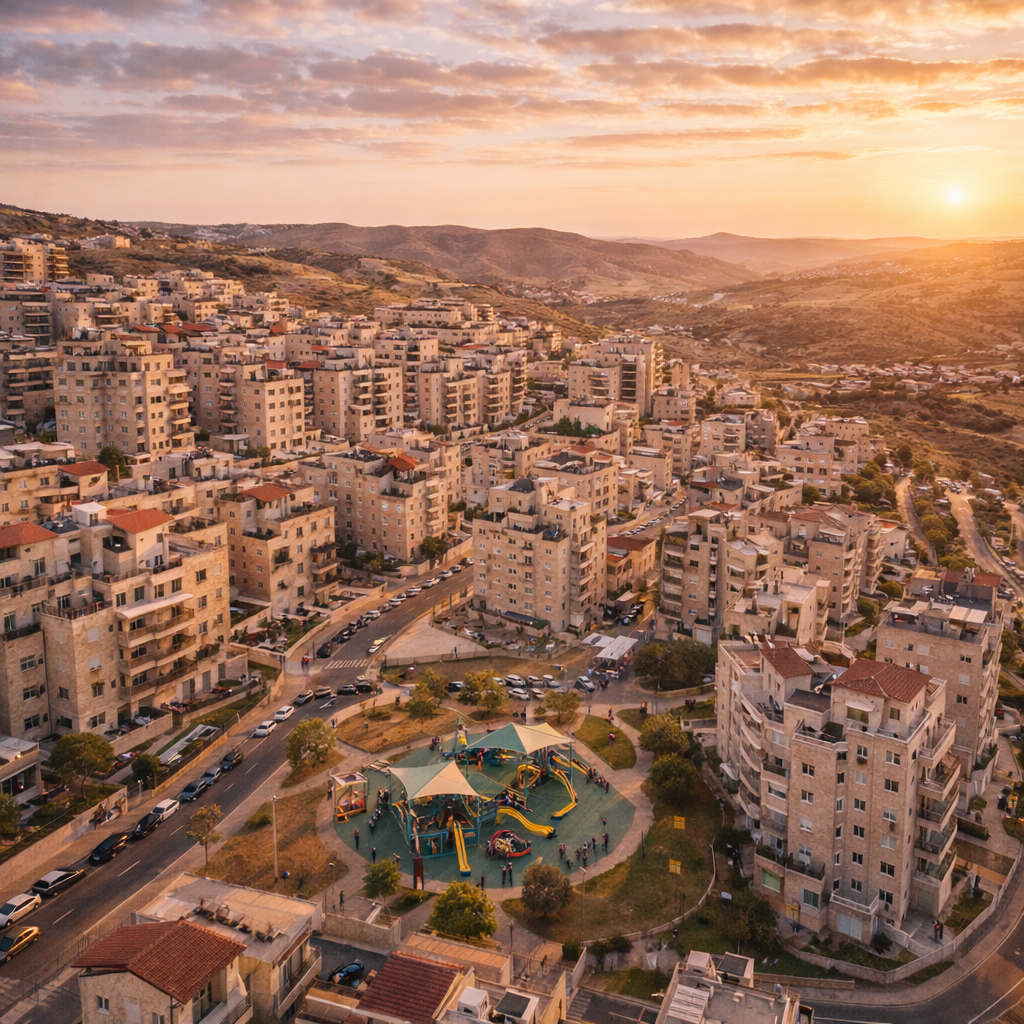
When you stand at the edge of Ramat Beit Shemesh Aleph and look south, the landscape opens up dramatically. The hillside drops away into the Nachal Yarmut Park, a beautiful green valley, and beyond that you can see the newer neighborhoods rising on the opposite slopes. This is Ramat Beit Shemesh Gimmel, one of the youngest and fastest-growing neighborhoods in Israel’s rapidly expanding Haredi world, a community that barely existed a decade ago but has already become home to thousands of families seeking a blend of modern amenities, suburban spaciousness, and authentic Torah life.
The story of Ramat Beit Shemesh Gimmel begins in 2009, when Israeli authorities announced plans to build a new largely Haredi neighborhood on a large block of state-owned land bordering southern Beit Shemesh. This wasn’t just about adding more housing to an already growing city. It was about creating space for a population that was expanding rapidly, both through natural growth and through immigration. By 2016, the Israeli Land Authority had published tenders for thousands of new apartments, and construction began in earnest on what would become one of the most ambitious residential projects in the region.
Ramat Beit Shemesh Gimmel is actually divided into two distinct areas, known locally as Gimmel 1 and Gimmel 2, or in Hebrew, Gimmel Aleph and Gimmel Bet. Each has its own character and timeline of development, though both share certain common features that make the neighborhood attractive to young Anglo families making aliyah. Gimmel 1, officially named Kiryat Avi Ezri, was the first to undergo construction, and it developed into a thriving neighborhood with remarkable speed. By 2018, the population had already reached approximately two thousand apartments, and as of 2024, it’s heavily populated with over three thousand apartments. The neighborhood is elevated on the mountain, offering views that look out over Ramat Beit Shemesh on one side and toward the beautiful hills of Gush Etzion and the forests of Park Britannia on the other.
What makes Gimmel 1 particularly appealing to the Anglo-Saxon public, as residents put it, is the lower-density building and larger apartments compared to many other Israeli neighborhoods. The many open spaces and parks give the area a suburban feel that resonates with families from places like Lakewood, Monsey, or Brooklyn who are used to having room to breathe. Walk through Gimmel 1 and you’ll see colorful playgrounds speckling every street, families strolling on Shabbat afternoons, and children playing in parks that were designed with families in mind. The neighborhood has become a popular destination for young families, with many synagogues, health clinics, stores, and schools now fully servicing the community.
Gimmel 2, officially called Kiryat Ovadia but often referred to simply as Gimmel Shtayim, is the second area of development and is positioned even closer to the original Ramat Beit Shemesh Aleph than Gimmel 1. The first residents moved into Gimmel 2 in early 2019, though some sources indicate the main influx began in 2020. The neighborhood is centrally located with easy access to the city entrance and exit, positioned on the hillside opposite the corner of Nachal Luz and Nahar Hayarkon. A newly built bridge connects it directly to Gimmel 1, making movement between the two sections seamless. As of recent counts, around nineteen hundred families have made their homes in Ramat Beit Shemesh Gimmel 2.
The Anglo presence in Gimmel is significant, particularly in Gimmel 1, where there seems to be a higher percentage of English speakers compared to Gimmel 2. In Gimmel 2, about three hundred families are Anglos, many of whom either moved in after spending a few years in Israel as newlyweds, or remarkably, some families who came straight off the boat from making aliyah directly into the neighborhood. There are also a large number of second-generation olim, children whose parents made aliyah and who speak English but are very well integrated into Israeli society. This creates an interesting dynamic where you have native English speakers alongside those who are culturally Anglo but linguistically Israeli.
The neighborhood is very olim-friendly, and people consistently describe it as extremely welcoming and helpful. In Gimmel 2, one particular building project stands out as the heaviest Anglo-Saxon area: the Wolfson project, which features beautiful architecture with arches and more than one hundred apartments in the complex. The blocks along Miriam Hanevi’a and Ovadiah streets are likewise home to many English-speaking families. While Hebrew is the main language of all the shuls in Gimmel 2, the community is very welcoming of English speakers, who typically adjust quickly to the environment.
The religious character of Ramat Beit Shemesh Gimmel is distinctly Haredi, but with considerable diversity within that framework. Gimmel 2 in particular is mainly yeshivish and Hasidic, with a very diverse Haredi population that includes all types: Yerushalmi, Sephardi, Hasidic of various dynasties, and more. The neighborhood has what residents describe as a very heimishe atmosphere with its diverse crowd and many shteiblech, those small, intimate prayer spaces that characterize Hasidic life. Although there is no official English-speaking rabbi yet, the area is home to many learned individuals, including retired Roshei Yeshivot who have settled there.
The shul scene in Gimmel 2 reflects this diversity. There are currently two official Litvish shuls, both under the leadership of Rabbi Meisels. Heichal HaTorah is completely Anglo, while Ayeles HaShachar has a large mixture of Anglos, second-generation Anglos, and Israelis. Furthermore, every Hasidic group in the neighborhood has its own shul. Rabbi Rabinowitz, a tremendous Talmid Chacham who recently authored a famous Halacha sefer, heads a Hasidic shtiebel called Tiferet Yaakov. This shul is klal Hasidi, meaning it’s not affiliated with any specific Hasidic dynasty but welcomes all. In Gimmel 1, there’s Kehillas Kol Yehudah, named after Harav Ben Zion Yehudah Leib Twerski of Hornosteipl, which represents the next chapter in the journey of the Twerski family and Hornosteipl Hasidus in establishing a community on the fertile ground of Eretz Yisrael under the guidance of Rabbi Shimon Twerski.
Education is a priority, as you would expect in any Haredi community, and both Gimmel 1 and Gimmel 2 have developed their own educational infrastructure. Many Hasidic chadorim have opened in the neighborhood. One is called Kehel Chasidi. There are also two Litvish or yeshivish chadorim. Ayeles Hashachar is taught under the hashkafa of Rav Shteinman and represents mainstream Haredi education. For elementary-aged girls, families typically send their daughters either to the Bais Yaakov in nearby Ramat Beit Shemesh Aleph or to the two Anglo schools there, Bnos Malka and Magen Avot. These schools provide transportation for students, though it can be a ten-to-fifteen-minute walk from the edge of the neighborhood. A Hasidic elementary girls’ school has also opened more recently. Additionally, there are two seminaries in the border area between Gimmel 1 and Gimmel 2, in an area called Hosha.
Beyond schools and shuls, the neighborhood has developed a full communal life. There’s an Anglo full-day kollel run by Rabbi Moshe Komornik, providing serious learning opportunities for men who want to continue their Torah studies while living in the neighborhood. Additionally, there are Daf Yomi shiurim and an evening kollel. For women, Gimmel 2 has an active Neshei organization. This is described as a very friendly English-speaking group that has organized a few events but mainly keeps in touch through email, supporting one another, giving friendly advice, helping each other, and being there primarily as a support network. There’s even been interest expressed in establishing a library for the community.
Daily life in Ramat Beit Shemesh Gimmel has a quieter, somewhat suburban feel, but residents are still very close to all the stores and institutions that Ramat Beit Shemesh Aleph has to offer. The relationship between Gimmel and Aleph is often compared to that between Boro Park and Flatbush, or between Lakewood and Toms River—separate communities with distinct identities but so close that residents of Gimmel have all their amenities at their doorstep. The neighborhood is built on a beautiful hill, and there are many steps, shortcuts, and paths connecting to other areas, giving it a walkable, interconnected quality despite the terrain.
Shopping in Gimmel has developed rapidly. Ramat Beit Shemesh Gimmel 2 alone has four shopping streets featuring two supermarkets, two butcher shops, a bakery, hardware store, bank, and a few other stores. Gimmel 2 already boasts three shopping centers with banks, clinics, and shops. Right on the outskirts, a large major mall was under construction, and residents proudly say that there’s never a need to leave Ramat Beit Shemesh to purchase any item. For those who want more variety, the proximity to Ramat Beit Shemesh Aleph’s Merkaz shopping center with over one hundred thirty stores is a huge advantage.
Healthcare is well covered in the neighborhood. Ramat Beit Shemesh Gimmel 2 boasts all four medical kupot cholim: Meuhedet, Clalit, Leumit, and Macabi, along with a pharmacy. This makes it easier for residents not to have to travel out of their neighborhood for any medical need. There are health clinics throughout both Gimmel 1 and Gimmel 2, ensuring that families with young children have easy access to pediatric care.
The housing stock in Gimmel is notably spacious by Israeli standards. Besides several villas on the border of Gimmel 1 and Gimmel 2 in the area called Hosha, all the housing consists of apartment buildings. But these are spacious, well-built apartments, and all come with an outdoor area, whether a yard or a large porch. The Wolfson project in Gimmel 2 has become one of the neighborhood’s most prominent landmarks, with beautiful architecture featuring arches and comprising over two hundred ninety-five apartments in twenty-three upscale residential buildings. This tremendously successful project helped establish an exceptionally high standard of building for Gimmel 2 and Ramat Beit Shemesh in general. The project is now sold out and available only on the second-hand market, a testament to its desirability.
The sense of community in Gimmel is palpable. Residents describe a very warm frum feeling where kids play on the street on Shabbos without having to be concerned about cars. There’s a big mix of all kinds of frum Yidden of every affiliation, yet people get along and create a cohesive neighborhood atmosphere. The many parks and greenery make it very beautiful, and families gather in these spaces, creating the kind of informal community connections that are the foundation of any successful neighborhood.
One unique feature of the area is its proximity to history. Just at the edge of Ramat Beit Shemesh Gimmel, residents need only cross the traffic circle intersection of Eliyahu Hanavi and Yeshayahu Hanavi Streets to find themselves stepping back in time. There’s an open field that has become a recent treasure of the archaeology community—an entire hill filled with ancient mikvaos dating back two thousand years. These ritual baths are mehudar according to halacha and have been preserved through millennia. While construction in Ramat Beit Shemesh was supposed to continue right up this hill, the discovery of the mikvaos has led to efforts to designate the area as a preserved heritage site. It’s a remarkable reminder that this land has been home to observant Jews for thousands of years, and the residents of Ramat Beit Shemesh Gimmel are simply the latest chapter in that long story.
The employment situation in Gimmel reflects the diversity of the Haredi world. There’s a mix of men either learning full-time or working. Most of the women bring in parnassa by working in typical jobs such as teachers, secretaries, or store employees, though there are several who work in more professional fields. This balance between learning and earning is characteristic of the modern Haredi Anglo community, where the value of Torah study is maintained alongside the practical recognition that families need to support themselves.
Transportation from Ramat Beit Shemesh Gimmel is quite manageable. Jerusalem is approximately thirty-five minutes by car and forty minutes by bus number four nineteen to Ramat Eshkol. In addition, there are buses constantly running to Bnei Brak and Beitar. People can definitely get around with public transportation easily, smoothly, and quickly. The neighborhood’s location means that whether you work in Jerusalem, in the growing tech sector in Beit Shemesh itself, or even commute to Tel Aviv, it’s feasible, though not necessarily easy for daily commuters.
What’s perhaps most striking about Ramat Beit Shemesh Gimmel is how quickly it has developed from empty hillsides into thriving communities. One longtime resident of Ramat Beit Shemesh Aleph recalls that just a few years ago, looking south from Aleph meant seeing distant hills and valleys. Today, those distant hills are fully built neighborhoods with thousands of families, multiple shopping centers, dozens of synagogues, and a full educational infrastructure. The growth truly feels sudden, and it speaks to the demographic vitality of the Haredi community and particularly the appeal of Beit Shemesh to Anglo olim.
The speed of development has been remarkable. Gimmel 1 went from first construction to a thriving neighborhood with over three thousand apartments and many synagogues, stores, clinics, kindergartens, and schools in just a few years. Gimmel 2 saw its first residents in 2019 or 2020 and within a few years had three shopping centers and multiple synagogues. This kind of rapid development requires not just construction but community building—establishing institutions, creating social networks, and developing the informal systems of mutual aid and support that make a neighborhood more than just a collection of buildings.
The residents of Ramat Beit Shemesh Gimmel have successfully created that sense of community. Whether through the English-speaking Neshei group in Gimmel 2, the various shiurim and kollelim, the multiple shuls catering to different hashkafic orientations, or simply the informal networks of neighbors helping neighbors, the neighborhood has quickly developed the kind of social infrastructure that makes aliyah sustainable. For many Anglo families, especially those who might be overwhelmed by jumping directly into a fully Israeli environment, Gimmel offers an attractive middle ground. You’re in Israel, you’re in a Haredi neighborhood, you’re integrating into Israeli society, but you’re also surrounded by enough English speakers and familiar institutions that the transition feels manageable.
The neighborhood is family-oriented in the extreme, with the wide selection of Haredi schools and the colorful parks on every street creating an environment where raising children feels natural and supported. The dynamic Neshei events provide social outlets for women, while the multiple kollelim and shuls offer men opportunities for serious learning and communal prayer. It’s a place where the priorities are clear: Torah study, family life, and community building, all set against the beautiful backdrop of the Judean hills.
Looking ahead, Ramat Beit Shemesh Gimmel seems poised for continued growth. With additional neighborhoods like Ramat Beit Shemesh Daled being developed nearby and the city of Beit Shemesh projected to continue its rapid expansion, Gimmel will likely continue to absorb new families, expand its institutions, and develop its character. The challenge will be maintaining the warm, heimishe atmosphere and the sense of community cohesion even as the population grows. But if the first years are any indication, the residents of Ramat Beit Shemesh Gimmel are up to the task, creating not just another housing development but a true Torah community where families can flourish, children can grow in their commitment to Yiddishkeit, and the dream of living in Eretz Yisrael becomes a daily reality wrapped in the familiar warmth of heimish, Anglo-friendly community life.