Ramat Beith Shemesh Aleph | Anglo Community
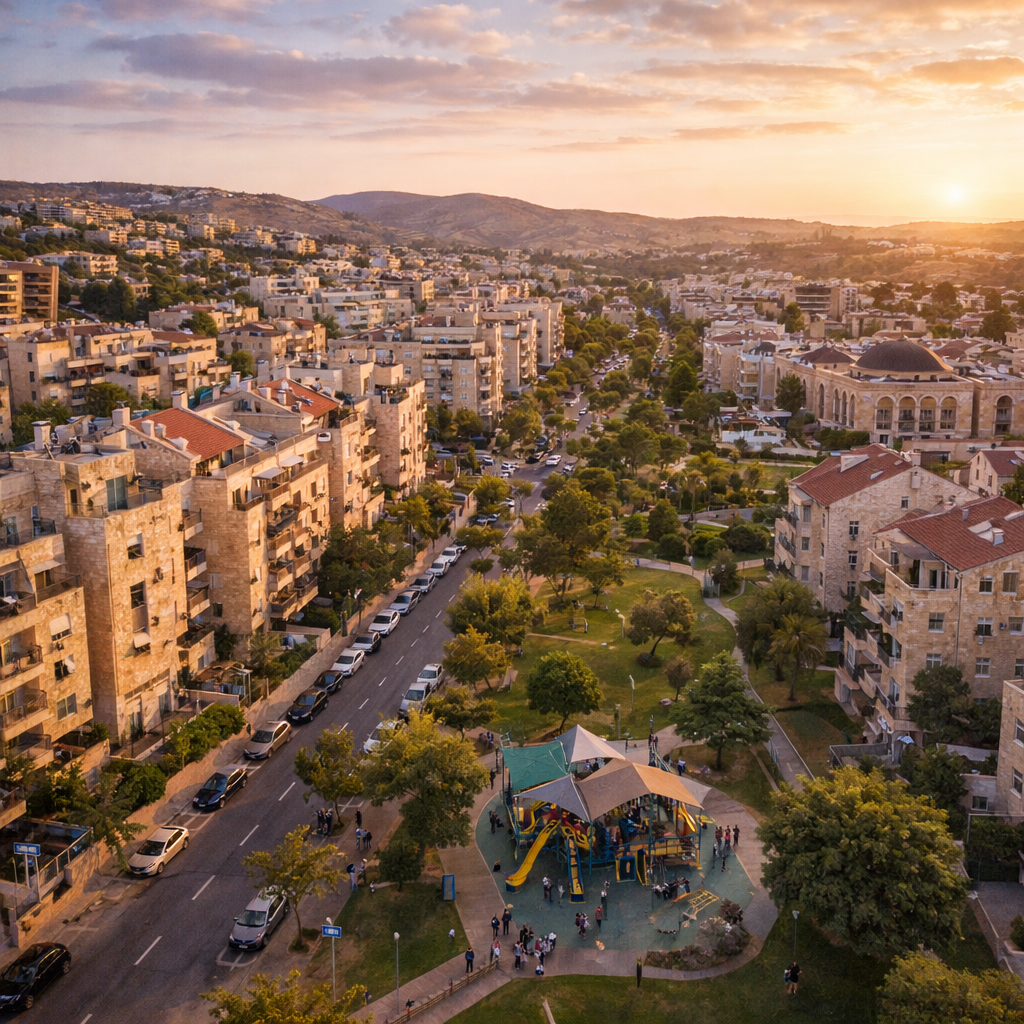
Ramat Beit Shemesh Aleph stands on a hillside overlooking the original town of Beit Shemesh, perched in the beautiful Judean hills about thirty-five kilometers southwest of Jerusalem. When you drive up the winding roads to reach this neighborhood, you’re climbing to what locals affectionately call “the Ramah,” a community that has transformed the landscape of religious Anglo aliyah to Israel over the past twenty-five years.
The story of Ramat Beit Shemesh Aleph begins in the mid to late 1990s, when construction first started on what would become one of the most significant experiments in Anglo-Jewish community building in modern Israel. The neighborhood was developed with a vision, a carefully thought-out plan to create a place where English-speaking families could raise their children as God-fearing Jews while maintaining respect for their Anglo culture. This wasn’t just about building houses; it was about creating a community with a distinct religious and hashkafic identity. The founders wanted rabbis who believed that being a working person, a baal habayit, didn’t make you a second-class citizen in the Torah world, and that’s exactly what they established.
Today, Ramat Beit Shemesh Aleph is home to approximately twenty-five thousand people, and remarkably, about forty percent of them are Anglos. But when you walk through the streets, the Anglo presence feels even more pronounced. English echoes from street corners, from the shops in the central shopping area called the Merkaz, and from the numerous synagogues that dot the neighborhood. It’s not uncommon to hear American accents discussing Torah, shopping for groceries, or arranging carpools, creating an atmosphere that feels familiar to families from places like Lakewood, Passaic, Flatbush, or Teaneck, yet distinctly Israeli at the same time.
The neighborhood isn’t monolithic. It’s divided into several distinct sections, each with its own character and flavor. There’s the Dolev section, which sits at a higher elevation and contains a heterogeneous mix of native Israelis and immigrants. The religiosity in Dolev varies considerably, from Haredi to Dati Leumi, or Modern Orthodox, with each group maintaining its own synagogues and schools. Yet there’s a beautiful integration here. At Masos Mordechai, for instance, all types come together to pray at all times of the day. The Dolev area is also home to the Matnas, a community center that services all types of Jews in the Ramat Beit Shemesh Aleph community, and Park Center, a mini-mall with various stores and restaurants.
Then there’s the Revivim section, positioned lower down the hill than Dolev. This area is populated mostly by Haredim, both Israeli and what locals call “Chutznikim,” meaning those from outside Israel, with religious levels ranging from what you might call American yeshivish all the way to more Israeli-style Yerushalmi families. The majority here are English speakers, and much of the neighborhood connects to American-style minyanim at shuls like the Gra, Pnei Shmuel, or Beis Tefillah Yonah Avraham. There’s a strong emphasis on living a Torah lifestyle that pervades this area. The streets here include Revivim, Ramot, Gilo, Noam, and Achziv, and if you remember them geographically from west to east and from lower to higher on the hill, you’ll notice that after Noam come what residents call the GRA streets, which culminate near the GRA shul.
The third major section is Mishkenos Yaakov, located right next to the Merkaz shopping center. Here the population is almost exclusively Haredi, both Israelis and English speakers, though the Anglo families tend to lean more toward their Israeli counterparts regarding religious and cultural issues. There’s an official rabbi, Rav Mordechai Goldstein, who serves as the Mara D’asra and is looked up to as the respected authority on religious questions and community projects. The Mishkenos Yaakov area is home to Lev Eliyahu, the synagogue with the most minyanim in all of Ramat Beit Shemesh Aleph.
Most of the Anglo community actually lives to the east of Park Ayalon, in areas around Refaim, Luz, Maor, Habesor, and Shimshon streets. This geographic concentration has created a critical mass of English speakers that supports everything from shiurim to social programs to gemachim, the free-loan societies that are a hallmark of the community’s chesed work.
Since the original development, Ramat Beit Shemesh Aleph has experienced rapid growth and expansion. In 2007, construction began on Ramat Shilo, considered a subdistrict of Aleph. More recently, new construction has spread to the lower slopes of the hill in an area called Mishkafayim, overlooking the Zanoah quarry. Mishkafayim is still developing but has already started to be populated entirely by Orthodox Jews of all strands, including Hasidic, Haredi, and Dati Leumi families. It currently has six minyanim and is becoming known for its leafy, suburban feel.
What really distinguishes Ramat Beit Shemesh Aleph from other Anglo communities in Israel is its educational infrastructure. The neighborhood was the first to establish schools with an intentionally American flavor within a Haredi framework. Magen Avos, founded eighteen years ago by American oleh Rabbi Doniel Simon, was the first Haredi elementary school to call itself “American-style.” It focuses on interpersonal relationships and includes secular education while maintaining a strong emphasis on kodesh, religious studies. This struck a deep chord among Anglo olim who wanted their children to have both a solid Torah education and the tools to navigate the modern world.
Since Magen Avos opened its doors, other schools have followed. Darchei Noam and Toras Moshe serve boys, while Bnos Malka serves girls. On the high school level, there’s Mesivta Beit Shemesh, a Haredi yeshiva high school where, unlike the Israeli yeshiva ketana system, boys study secular subjects alongside their Torah learning. Many of these schools have built-in ulpan programs specifically designed to help olim children learn Hebrew while maintaining their English at a high level, an accommodation that’s critical in the acclimatization process.
There are also the Ahavat Yisrael schools, which combine Torani education with serious secular studies for bagrut matriculation. The boys’ school focuses on in-depth Torah learning in the mornings, including Gemara, Halacha, Jewish philosophy, and mussar, while afternoons are devoted to intensive secular studies. The educational philosophy holds that excellence in Torah and secular knowledge go hand in hand, and students are encouraged to participate in community service projects. The girls’ ulpana offers a similar framework, fostering social responsibility and leadership among young women.
The synagogue scene in Ramat Beit Shemesh Aleph is remarkably diverse. Beis Tefillah Yonah Avraham was founded in the year 2000 to meet the needs of new olim looking for community support and a sense of belonging. Members come from numerous countries, including the United States, Canada, the UK, South Africa, Australia, Russia, France, and Peru. The kehilla hired Rabbi Chaim Zev Malinowitz, who received his rabbinic ordination from Rabbi Moshe Feinstein and also served as General Editor of the Artscroll Schottenstein Edition of the Talmud. The shul started in a covered parking lot and eventually moved to a large facility with a four-thousand-square-foot main sanctuary, a large women’s section, and a simcha hall.
Kehillas HaGra, known simply as “the Gra Shul,” is another cornerstone of the American-style kehilla model, where the rabbi serves as someone to turn to for life guidance and shul members form a supportive social network. There’s also a Chabad presence, a Carlebach-style minyan, and even a shul that follows in the tradition of Rabbi Soloveitchik. Shivtei Yeshurin has the feel of an Anglo-American baal habayit shul under the leadership of Rabbi Yaakov Haber. The diversity extends to Sephardic Anglos as well, though the main Sephardic Anglo community, Meam Loez, is actually in a different part of Ramat Beit Shemesh.
Shopping and daily life in Ramat Beit Shemesh Aleph revolves around the Merkaz, the central shopping area with over 130 stores. There are four supermarkets in the neighborhood, and many of them stock American products that make the transition easier for new immigrants. The newest park is Yarmut Park, the biggest in all of Beit Shemesh, and the neighborhood is dotted with numerous other parks and public areas that are well maintained, giving children safe spaces to play and families places to gather after davening.
The community is also home to a remarkable network of chesed organizations. Hatzola Beit Shemesh is an independent organization that combines first response and follow-up care for emergency medical situations. Kupa Shel Tzedaka is a major charity organization that helps needy families rehabilitate themselves to self-sufficiency. Ezrat Achim provides medical aid like trips to the hospital, x-rays, and loans of medical equipment. Mishkan Adei Ad assists needy families with the vast expenses of making weddings. And Hakeshiva focuses on prevention of, and aid to, teens-at-risk, reflecting the community’s recognition that even in this supportive environment, adolescents face challenges.
Transportation from Ramat Beit Shemesh Aleph is quite convenient for a hilltop community. Various bus lines interconnect the neighborhoods and provide service to Jerusalem approximately every ten to fifteen minutes, depending on the time of day. The commute to Jerusalem is typically thirty-five minutes to an hour by bus or car, while Tel Aviv is under an hour away. This makes the neighborhood attractive to families where one or both parents work in either city. There’s also train service connecting to northern cities like Haifa, Afula, and Karmiel.
One of the most interesting aspects of Ramat Beit Shemesh Aleph is how it allows families to integrate into Israeli society at their own pace. Unlike some other communities in Israel where new immigrants feel pressure to immediately adopt Israeli customs and language, Ramat Beit Shemesh Aleph provides a buffer, a soft landing where children can attend schools with ulpan programs, where parents can find doctors and government services that operate in English, and where the cultural norms feel familiar even while living in Israel. This has completely revolutionized the concept of aliyah for many religious families.
The community has also become something of a laboratory for new approaches to religious life in Israel. Rabbi Karmi Gross, a resident of Ramat Beit Shemesh, took note of the growing population of people who identify as Haredi but want to play a larger role in Israeli society, and he established Beit Midrash Derech Chaim, Israel’s first Haredi hesder yeshiva. The students learn Torah for six to seven hours a day, then study computers at a university level at night. They graduate with a degree in Computer Science specializing in cyber technology and then serve for two years in tech units in the IDF. The boys enter the army with the mission of sanctifying God’s name and hoping to serve as a bridge between various camps by maintaining what they call “boundaries but not walls.”
It’s worth noting that each street in Ramat Beit Shemesh Aleph can have its own character and mix of people. Even within the same section, adjacent streets or buildings may have different hashkafic orientations. This granularity means that families moving to the area need to do careful research about which specific street or even which building would be the best fit for them. Some streets are heavily Anglo, others more Israeli. Some lean more yeshivish, others more baal habatish with working families. This diversity within diversity is seen as both a strength and something that requires navigation.
The English-speaking residents work hard to make newcomers feel part of the community. The variety of shuls and schools means that almost everyone can find a place where they feel they belong. Whether you’re looking for a serious learning community, a working-family atmosphere, a Hasidic environment, or something more modern within the Orthodox spectrum, there’s likely a street, a shul, and a school in Ramat Beit Shemesh Aleph that will feel like home.
Of course, no community is perfect, and Ramat Beit Shemesh Aleph has faced its share of challenges. The broader city of Beit Shemesh has experienced tensions between different religious groups, though these have largely been concentrated in other neighborhoods. There are the normal challenges of any growing community, questions about maintaining standards, concerns about at-risk youth, and the ongoing work of building and maintaining institutions. Some residents note that moving to the area with older children can be particularly challenging, and educators generally recommend that families with teenagers be especially thoughtful about which specific subcommunity within Aleph would work best.
But what emerges most clearly from conversations with residents and from the community’s history is a sense of achievement and pride. Ramat Beit Shemesh Aleph has shown that it’s possible to create a vibrant Torah community in Israel that honors both Anglo culture and serious religious commitment, that values both learning and working, that maintains high standards while being welcoming to newcomers. For many families, it represents the fulfillment of the dream of aliyah, living in the land of Israel while surrounded by a warm, caring community that speaks your language, shares your values, and supports you in raising the next generation of committed Jews. The neighborhood continues to grow, with new construction projects adding to its housing stock and new families arriving each year, drawn by the combination of location, community, educational opportunities, and that distinctive blend of American warmth and Israeli vitality that makes Ramat Beit Shemesh Aleph truly unique.