Nofei Hashemesh | Anglo Community
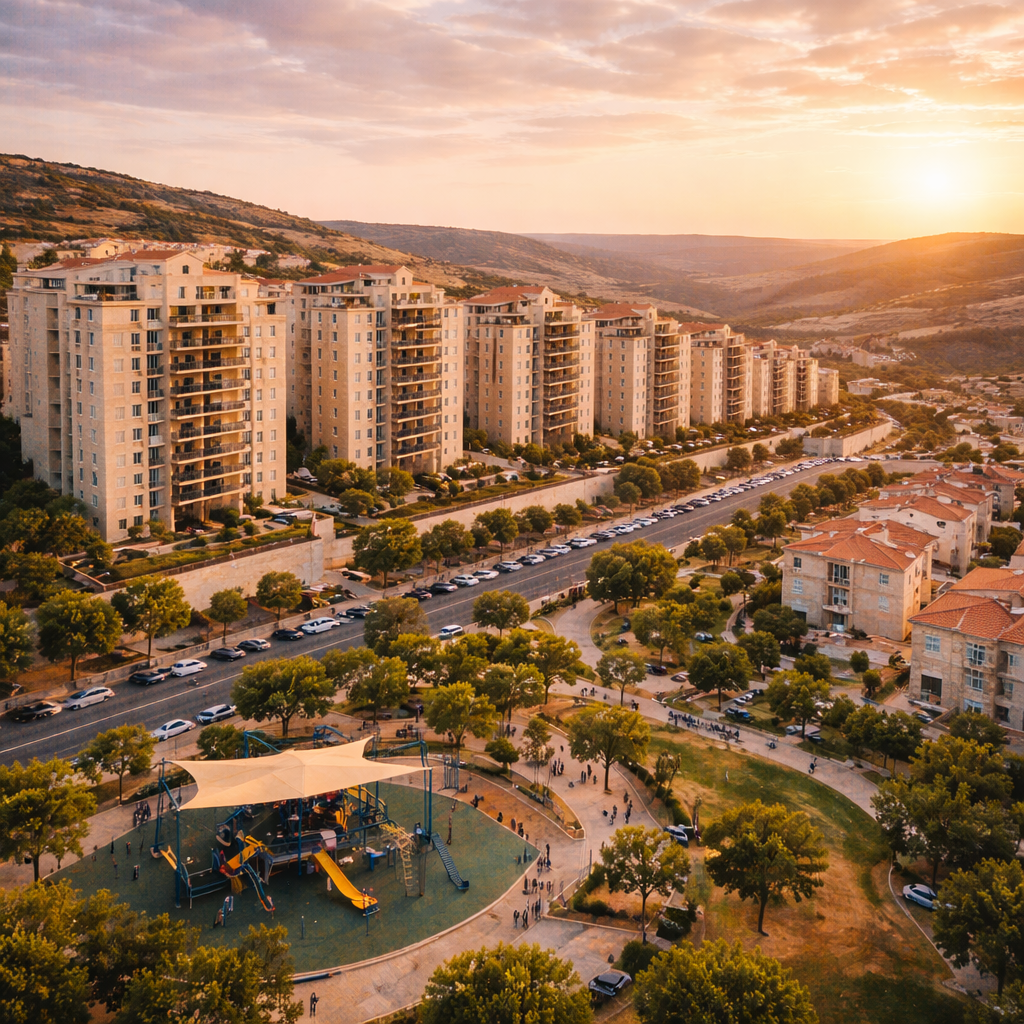
In the early 2000s, when real estate developers committed to building a line of elegant townhouses along the north side of a not-yet-paved road across a steep hill in Beit Shemesh, they were creating something that would become far more than just another housing development. They named the road Rehov Hasitvanit, after a local wildflower called the sitvanit or autumn crocus, and they called the neighborhood Nofei Hashemesh, meaning “Sunscape” or “Landscape of the Sun,” echoing the name of the city itself, Beit Shemesh, “House of the Sun.” What they couldn’t have predicted was that this neighborhood would pioneer a revolutionary model for building Anglo communities in Israel, one centered not around shared ethnicity or economic class but around inspired rabbinic leadership and the American synagogue model transplanted to Israeli soil.
The key insight that transformed Nofei Hashemesh from just another real estate project into a community-building phenomenon came from Shelly Levine, the American-born real estate powerhouse who had already revolutionized Anglo settlement in Beit Shemesh with the Sheinfeld project in the early 1990s. When the developers, two of Israel’s biggest real-estate firms, Yesodot Zur and Kurdan, initially conceived Nofei Hashemesh, it was meant to be just another property development. Then they realized that branding it as a religious-Zionist community would help them sell in what was becoming a difficult market during the global economic slowdown of 2008.
But Levine saw further. In early 2008, she hit upon an innovative strategy: if you can get a respected rabbi from America to move in, the rabbi will start a synagogue, and the community will grow around the synagogue. This was not just marketing genius, though it was certainly that. It was based on a profound understanding of what American Orthodox Jews value and miss when they make aliyah to Israel. Most Israeli synagogues do not have a rabbi, and if they do, the rabbi tends to be appointed and salaried by the state, serving a geographic area rather than a specific congregation. The American model of a charismatic rabbi who serves as pastoral head, religious guide, teacher, and communal organizer is largely absent in Israel, and its absence leaves many American immigrants feeling spiritually adrift.
In May 2008, Levine recruited Rabbi Shalom Rosner to take on the challenge of founding Kehillat Nofei Hashemesh. It was a brilliant choice. Rabbi Rosner, then thirty-five years old, was already a well-known figure among graduates of Yeshiva University, where he had taught Talmud, Bible, and Jewish Law for seven years. He was the rabbi of Congregation Bais Ephraim Yitzchok in Woodmere, New York, a growing and successful shul in the heart of the Five Towns. He had recorded explications of classical Jewish texts that were followed by thousands of students around the world. His shiurim were known for their ability to clarify the most complex Talmudic passages while maintaining warmth and accessibility. He was, in short, exactly the kind of rabbi who could inspire people to uproot their lives and follow him to a new community.
When Rabbi Rosner announced in April 2008 that he and his family were moving to Israel, Jewish publications across the United States carried an advertisement signed by many of the leading Orthodox rabbis in America congratulating him and urging American Jews to consider joining him. This public endorsement from the rabbinic establishment was unprecedented for a community that didn’t yet exist, a neighborhood where only a few townhouses had been completed and most of the land was still under construction. But it worked. The rabbi’s star power, combined with the innovative community model and Levine’s marketing expertise, created buzz that transcended typical real estate promotion.
Rabbi Rosner and his wife, Dr. Tamar Rosner, a pediatrician, along with their six children, moved to Nofei Hashemesh in the summer of 2008. They were given incentives in housing to settle there, with the developers understanding that the rabbi’s presence was the linchpin of the entire project’s success. This was acknowledged as the first time this model had been used by a property developer in Israel, though the concept of an American rabbi making aliyah and encouraging congregants to join him was not entirely new. Rabbi Shlomo Riskin had done something similar in 1983 when he moved from his Lincoln Square Synagogue in Manhattan to Efrat, taking several congregants with him.
But Nofei Hashemesh was different in important ways. Efrat was a settlement in the West Bank with all the ideological freight that entailed, attracting primarily committed religious Zionists willing to live beyond the Green Line. Nofei Hashemesh was in Beit Shemesh, fully within the 1967 borders, accessible to mainstream American Jews who supported Israel but weren’t necessarily settlement ideologues. And while Riskin’s move was driven primarily by his own ideological commitments, the Nofei Hashemesh model was explicitly engineered by developers and realtors to create a marketable product. This commercialization didn’t make it less authentic or meaningful, but it did represent a new chapter in how Anglo communities could be built.
Rabbi Rosner framed the move in terms that resonated with his target audience. He described making aliyah to Nofei Hashemesh as an opportunity “to beat the mashiach rush,” a humorous but pointed reference to the belief that when the messiah comes, all Jews will need to move to Israel anyway. Better to come now, establish yourself, build a community, and be ready. He also offered a reconceptualization of chalutziut, the Zionist concept of pioneering. “We’re not going up to a mountain top and setting up caravans,” he said, “but there is a sense that building a new type of community for Israel, based around the synagogue and the rabbi, is pioneering.”
This reframing was important. Pioneering in Israel had traditionally meant physical hardship, ideological commitment to settling the land, agricultural labor, or security concerns. Rabbi Rosner was proposing a different kind of pioneering: importing American Jewish communal structures to Israel, demonstrating that you could have vibrant Torah community life with engaged rabbinic leadership in the Holy Land. For American Modern Orthodox Jews who wanted to make aliyah but worried about losing the community warmth and rabbinic guidance they valued at home, this was compelling.
The physical development of Nofei Hashemesh consisted of approximately 400 housing units, a significant project that would take years to complete. The housing included elegant townhouses along Rehov Hasitvanit, stand-alone villas that were exceptionally spacious and well-designed, two-family semi-attached cottages with six rooms and finished basements, and apartment buildings with units ranging from two to four bedrooms. This variety meant the neighborhood could accommodate families at different economic levels and with different housing preferences, though the prices were not cheap. Still, the developers were banking on the value proposition of community rather than just square footage.
The first families began moving in during 2008, even as construction continued around them. Jason Schwartz and his family, arriving from New Jersey, were among the pioneers. They had already planned to make aliyah to Beit Shemesh and were choosing between neighborhoods when a just-completed townhouse on Rehov Hasitvanit caught their attention. It seemed well-built and spacious, but more importantly, building a new community seemed like an adventure. Jason and his wife Chani had known Rabbi Rosner and Dr. Tamar Rosner since their school days, which gave them confidence in the community vision.
Chana Berkovits, a twenty-five-year-old mother of two from Staten Island, arrived with her family in September 2008 and moved to Nofei Hashemesh in October. “Rabbi Rosner attracted us,” she explained. “He has made a name for himself and we figured that it can’t be a bad community if he’s coming.” She added that they were used to having a strong connection with a synagogue and rabbi, and without that they would have felt lost. They had tried living in Jerusalem for a month after arriving in Israel and didn’t feel a sense of community, which they didn’t like. Nofei Hashemesh offered what Jerusalem couldn’t: instant community cohesion around a shared vision and leadership.
What’s remarkable about Nofei Hashemesh is that from the very beginning, it was not exclusively Anglo, despite being marketed primarily to English speakers. Even the founding members of Kehillat Nofei Hashemesh included Israeli-born families alongside the American immigrants. Rabbi Amir Avraham, who became one of the founding members, was born in Ethiopia. His family had escaped to Sudan, living in a refugee camp for three years before flying to Israel. He arrived shortly before his bar mitzvah. What attracted him to Beit Shemesh was an unusual story involving basketball players who had impressed him as a teenager with their politeness and inclusion. After serving in the IDF as a paratrooper, he chose to build his life in a community that valued the kind of respectful, warm interactions he had experienced.
This ethnic and national diversity became a defining feature of Nofei Hashemesh in ways that distinguished it from neighborhoods like Sheinfeld or Nofei Aviv, which remained more homogenously Anglo. Walking through Nofei Hashemesh today, you see children of all colors playing together, Black, white, and shades of brown in between. At the playground up the hill, little children clamber around play structures without any self-consciousness about their different appearances or backgrounds. At the end of the school day, students swarm out of schools walking together, thoroughly integrated. Everyone is Jewish, everyone is fairly observant, but they trace their ancestry to far-flung parts of the world.
Avner Shlomi, a native Israeli whose family roots go back to Yemen, lives on Rehov Hasitvanit among the Anglo families. When asked how he ended up in this neighborhood, he mentions Rabbi Rosner near the top of his list of reasons. “My Rosh Yeshiva in Israel approved,” he said, indicating that for Israeli religious Zionists, rabbinic endorsement of a community mattered just as much as it did for Americans. The presence of Rabbi Rosner created a gravitational pull that transcended national origin.
On Rehov Rabbi Yannai, a fishhook-shaped street adjacent to Rehov Hasitvanit where apartment buildings were constructed after the initial townhouses, the diversity becomes even more apparent. Linda and Gary, who moved there, discovered they had many friends in the neighborhood already, which eased their transition. They enjoy living in an apartment building with people of all ages and different backgrounds. Linda has made a particular contribution by translating for other Anglo residents who have not mastered Hebrew, some of whom have lived in Israel for decades, getting along on English and helpful neighbors.
The kehilla that Rabbi Rosner built became the center of community life, just as Shelly Levine had envisioned. Unlike many Israeli synagogues where davening is the primary or only activity, Kehillat Nofei Hashemesh offers what Americans expect: youth activities, lectures, events, shiurim for men and women, social programming, and the constant presence of a rav who knows every family and is available for guidance. Rabbi Rosner’s popular Daf Yomi shiurim on both Bavli and Yerushalmi, his Parshat HaShavua classes, his Nach series, and his Sefer HaMitzvot lessons are broadcast online and followed by thousands of students globally through platforms like OU.org and apps like AllDaf and AllParsha. This means that even as he serves his local community, he maintains a worldwide teaching presence.
The kehilla’s website, established early on, became a hub for information and connection, allowing potential olim to learn about the community before making the leap. The site features family profiles of residents, explaining how they came to Nofei Hashemesh and what their experience has been. David and Lisa Schlussel from New Milford, New Jersey arrived in 2010 with their five children. Ari and Rachel Gruenspecht from Teaneck made aliyah in 2010 with their four children. Yossi and Sharon Lupas came from Toronto in 2007. These testimonials, featuring real families with familiar backgrounds, helped prospective residents envision themselves in the community.
The challenge of establishing communal infrastructure in a brand-new neighborhood became apparent in 2010 when the Beit Shemesh municipality initially refused to allocate land for a permanent synagogue building. The mayor’s office claimed that with only thirty apartments inhabited out of a planned 700, they didn’t find it appropriate to give the only public area in the neighborhood for a shul. This sparked a controversy that revealed underlying tensions between the Modern Orthodox community and the increasingly Haredi-dominated municipal government.
Jason Schwartz, who served as president of Congregation Nofei Hashemesh, organized a demonstration against the municipality’s decision. The pressure worked. Within weeks, the mayor and certain city council members reversed course, expressing support and providing a location for a temporary structure while bringing the request for a permanent site back to the municipality land allocation committee. The victory was celebrated as a significant success, demonstrating that the Anglo community could organize and advocate effectively for its needs. Rabbi Rosner spoke of “real teamwork, with all elements of the city council working to advance our interests.” The episode became a template for community organizing in Beit Shemesh.
Rabbi Rosner’s rabbinic career continued to evolve alongside his community-building work. For ten years he taught on the staff of Yeshivat Reishit Yerushalayim as a maggid shiur in the Masmidim track, teaching advanced students in both Shana Aleph and Bet programs. He then taught for six years as a senior Ram at Yeshivat Kerem B’Yavneh, revitalizing their overseas program. In September 2024, he assumed the position of Rosh Beit Midrash of the English Speaking Program at Machon Lev-Jerusalem College of Technology. During summers, he serves as Camp Rabbi and Educational Director at Camp Kaylie. This combination of roles means he interacts with hundreds of students and families beyond just Nofei Hashemesh residents, expanding his influence and bringing energy back to the community.
The housing in Nofei Hashemesh has appreciated significantly since the early sales in 2008-2009. What started as an ambitious project during a global recession proved to be a prescient investment. The combination of quality construction, strong community institutions, excellent location near key thoroughfares and shopping hubs, and the continuing growth of Beit Shemesh created steady demand. By 2025, the neighborhood is fully developed and mature, with trees that have grown, playgrounds that are established, and institutions that function smoothly.
The educational options for children in Nofei Hashemesh include schools within the neighborhood and nearby areas. Families have access to Modern Orthodox educational institutions that emphasize both Torah learning and secular education, prepare boys for meaningful army service, and encourage girls to pursue higher education and careers. The proximity to other Anglo neighborhoods like Sheinfeld means children can attend schools across several neighborhoods, creating social networks that extend beyond Nofei Hashemesh itself.
The Nofei Hashemesh model has been recognized as worthy of emulation. Shelly Levine, in her marketing materials, expressed belief that “Nofei Hashemesh will not only represent a huge success in its own right, but will also serve as a very positive model to be emulated in other locales throughout Israel.” This prediction proved accurate. The idea of building a community around an imported American rabbi who brings congregants with him has been tried in various forms since Nofei Hashemesh, though few have replicated its success. The specific chemistry of rabbi, developer, marketer, and timing proved difficult to duplicate.
Sociologist Ephraim Tabory of Bar-Ilan University, an expert on religion in Israel, noted that American immigrants often express a feeling that they want to increase their Jewish involvement when making aliyah, not decrease it, but when they arrive they lack the strong connection with rabbi and synagogue they had in America and actually feel their Jewish involvement declining. Nofei Hashemesh addressed this problem directly by recreating the American synagogue model in Israel. Residents didn’t have to give up the communal structure they valued; they brought it with them.
The neighborhood has evolved over the years beyond its initial Anglo character, with more Israeli families moving in as the community’s reputation spread. The integration of Ethiopians, Yemenites, Ashkenazi Israelis, and immigrants from various countries has created what one resident called a “microcosm of Jewish Israel.” Children grow up exposed to the full diversity of the Jewish people, learning that being frum can mean many different things, expressed through many cultural traditions, united by commitment to Torah and the Land of Israel.
Seventeen years after its founding, Kehillat Nofei Hashemesh continues to be described as “constantly expanding” on its website. This growth is not just numerical but also in depth of programming, maturity of institutions, and sophistication of communal life. The pioneering families who arrived in 2008 to half-finished homes and unpaved roads now live in an established neighborhood with mature trees, functioning infrastructure, and the kind of settled feeling that only comes with time. Their children, many of whom were young when they arrived, are now teenagers and young adults, some serving in the army, some in yeshiva or seminary, embodying the successful integration of American and Israeli identities.
Rabbi Rosner himself has become a significant figure in the Israeli Torah world, not just as a community rabbi but as a teacher whose shiurim reach thousands, as an author whose books are studied widely, and as a model for what engaged American rabbinic leadership can look like in Israel. His comprehensive Hebrew-English bencher, enriched with his commentaries and reflections, exemplifies the kind of contribution American rabbis can make: bridging languages and cultures, making tradition accessible and meaningful in new contexts, and demonstrating that you can be fully American and fully Israeli, fully Torah and fully engaged with modernity.
Looking back, the Nofei Hashemesh experiment demonstrated several important principles about building Anglo communities in Israel. First, that inspired leadership matters more than housing stock or location. Second, that Americans value community structures built around rabbinic guidance and pastoral care, and they will pay a premium for it. Third, that diversity enriches rather than threatens community cohesion when there’s shared religious commitment and leadership. Fourth, that pioneering can take many forms, including the importation of successful Diaspora models to Israel. And fifth, that with vision, courage, and the right leadership, you can build from scratch communities that rival established neighborhoods in depth and quality.
For families considering aliyah today, Nofei Hashemesh stands as proof that the American Modern Orthodox community model can not only survive in Israel but thrive, enriching Israeli society with its emphasis on engaged rabbinic leadership, warm communal culture, and synthesis of Torah with professional life. The elegant townhouses on Rehov Hasitvanit, built across that steep hill named for a wildflower, have become home to a flourishing community that continues to live out the founding vision of beating the mashiach rush, one family, one shiur, one act of chesed at a time.