Neve Remez | Anglo Community
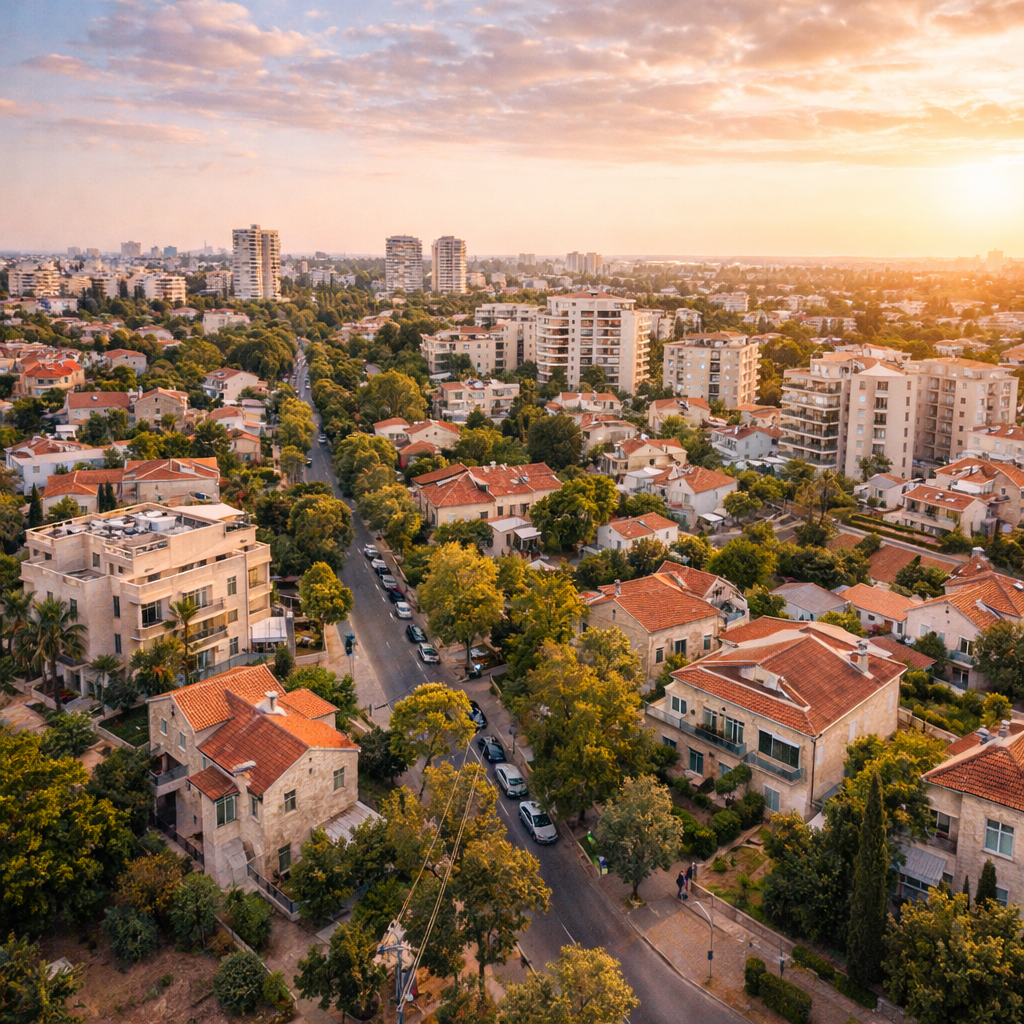
When you drive into Zichron Yaakov from the south, entering from the neighboring town of Binyamina, you pass through a secluded area that locals simply call “Remez.” The name carries weight here, not just as a geographic designation but as a memorial to one of the most significant labor leaders in Israeli history and a reminder of an era when workers’ welfare shaped the very infrastructure of the developing state. Neve Remez is a neighborhood with a single road in and out, creating a particularly quiet enclave with what residents describe as a special community feel, and its story weaves together the personal history of a founding father, the socialist idealism of the Histadrut labor federation, and the waves of immigration that transformed Israel in its early decades.
The neighborhood takes its name from David Remez, though he was born in 1886 as Moshe David Drabkin in the village of Kopys in what was then the Russian Empire’s Mogilev Governorate, in what is now Belarus. The change from Drabkin to Remez came when he married, adopting his wife’s maiden name, perhaps because it sounded more authentically Hebrew than his birth surname. This choice reflected a broader pattern among early Zionist pioneers who sought to shed their diaspora identities and create new Hebrew personas in the land of Israel.
Remez’s journey to Palestine began in 1913 when he arrived as a newly married man. After attending high school and studying law in Constantinople, he had worked briefly as a teacher, but his real calling would emerge in the soil of the land itself. For five years, from 1913 until after World War One, Remez worked as an agricultural laborer in several settlements including Ben Shemen, Be’er Tuvia, Karkur, and crucially for our story, Zichron Yaakov. During the First World War, he and his wife moved to Zichron where he worked as a laborer, treating exiles from Tel Aviv and Jaffa among other tasks. It was during this period in Zichron that Remez met Dr. Hillel Yaffe, the pioneering physician whose hospital served as the only Jewish medical facility north of Jaffa. Remez became Yaffe’s right-hand man in managing public affairs, a partnership that marked the beginning of his transition from manual labor to organizational leadership.
When the moshava was conquered by the Turks during the war, the Remez family relocated to Tel Aviv, but Zichron had already claimed a piece of his heart. His agricultural laboring days didn’t last long after the war ended. By 1921, Remez had become head of the national construction company Solel Boneh, which he himself had founded. In this capacity, he bought lands and initiated affordable housing projects throughout the developing Jewish community. He also served on Tel Aviv’s city council from 1921 to 1925 and became a founding member of David Ben-Gurion’s Mapai party.
Under the mentorship of Berl Katznelson, one of the intellectual architects of Labor Zionism, Remez rose to become Secretary General of the Histadrut, the all-powerful workers’ union that was far more than just a labor federation. For nearly a decade in this role, beginning in 1930, he was instrumental in founding many subsidiaries that would become pillars of the Israeli economy: the Zim shipping company, the Mashbir department stores, and the Am Oved publishing house, all of which continue to thrive today. Between 1944 and 1949, he chaired the Va’ad HaLeumi, the Jewish National Council that governed the Jewish community under the British Mandate.
His signature on Israel’s Declaration of Independence is distinctive. While Ben-Gurion’s signature stands out for its size, Remez’s is the one that catches the eye from a distance because he used a very thick fountain pen, making it the darkest signature on the document. It’s also the only signature that includes Hebrew vowel marks, reflecting his deep attachment to Hebrew language and his linguistic flair. When the State of Israel was declared on May 14, 1948, Remez became the country’s first Minister of Transportation, serving until 1950 when he took on the education and culture portfolio in the second government.
When Remez died on May 19, 1951, just four days before his sixty-fifth birthday, it was according to his last will and testament that he be buried in Zichron Yaakov beside the graves of his parents, not in Jerusalem or Tel Aviv where he had spent most of his career. The funeral was a state affair. His remains were borne through Jerusalem in a procession of one hundred cars that moved slowly through streets lined with tens of thousands of men, women, and schoolchildren who came for a glimpse of the coffin. Police and Army detachments headed the cortege, with schoolchildren bearing Israeli flags in the van. The procession halted twice in Jerusalem, once before the Knesset building where Minister of Justice Pinchas Rosen eulogized him on behalf of the government and Parliament, and again in front of Histadrut headquarters where the federation’s secretary-general spoke of Remez’s contributions to the labor movement. Then the procession made its way north to Zichron Yaakov, where he would rest in the cemetery that also holds Sarah Aaronsohn of the Nili spy ring and other pioneers of the First Aliyah.
The neighborhood that bears his name came into being during Israel’s first decade, in the late 1940s and early 1950s, when Neve Remez was built along with its neighbor Neve Sharet in the southern part of Zichron. In those early years, Neve Remez was known as Shikun Neve Oved Alef, housing for workers, a modest neighborhood populated by blue-collar laborers. The community was founded in 1947, but it was only upon the construction of the convalescent home called Beit Remez that the neighborhood was finally connected to the country’s electrical grid, showing how much the facility transformed the area’s basic infrastructure.
Beit Remez, the convalescent home built in the early 1950s like many similar facilities across the country, represented a remarkable vision of workers’ welfare that was practically unprecedented anywhere else in the world at that time. The Histadrut’s health fund considered stays at convalescent homes an extremely important part of healing and preventive health care. The rationale was clear: workers in Israel’s early years lived under difficult conditions with long hot summers, dynamic fast-paced lives, constant security threats from wars and terrorist attacks. An annual vacation at a convalescent home became one of the basic privileges the Histadrut offered its members, a direct expression of its welfare policies and social safety net. Tens of thousands of laborers and workers were hosted at these centers at the expense of their employers through the health fund system.
The convalescent home contributed tremendously to Neve Remez in multiple ways. It provided many jobs for local residents, giving the neighborhood an economic foundation. But more than the employment, Beit Remez was responsible for creating a feeling of community among the residents. It served as their cultural center, a gathering place that brought neighbors together and created social cohesion. You can see a photograph from 1962 showing Zvia and Danny Ludmer relaxing in the pool at the Beit Remez Convalescent Home, capturing the leisurely atmosphere that these facilities provided for workers who needed respite.
The neighborhood’s character was formed in large part by waves of immigration. Many new immigrants from all over the world gathered in this small neighborhood, which served as a melting pot particularly for those from Morocco, Turkey, Iraq, Tripoli, Romania, and Poland. These weren’t wealthy immigrants or those with professional credentials. These were working people, often arriving with little more than their determination to build new lives. The residents formed close social ties and networks of mutual assistance born from shared struggles and hopes. Remarkably, even though many years have passed since those early days, these bonds continue to exist in the community, and they continue to attract new residents into the circle of what has become a tight-knit social fabric.
The physical layout of Neve Remez reinforces this sense of community. Built around a beautiful park with a large central grassy area, the neighborhood has only a single road in and out. This creates what urban planners call a cul-de-sac effect, limiting through traffic and ensuring that the only people driving through are residents or their guests. This single-entry configuration allows residents to enjoy maximum peace, security, and that sense of community cohesion that comes from knowing your neighbors and recognizing who belongs.
Over the decades, the neighborhood has evolved from its modest workers’ housing origins. New houses have been built, bringing welcome revival and renewal to the area. The transformation has been significant. Today, Neve Remez boasts green lawns, sea views from certain properties, and walking paths that make it one of the most desired locations in Zichron Yaakov. Once considered a rather humble neighborhood, even described in some historical accounts as having been literally a swampland when Yemeni immigrants first settled portions of it in the 1950s, it has become sought-after real estate.
The location offers considerable advantages. Neve Remez sits conveniently on Binyamina Road, meaning residents can quickly reach the train station in Binyamina and access the Yokneam road for connections to other parts of the country. This accessibility makes it practical for commuters while maintaining that somewhat rural and peaceful character that defines the neighborhood’s appeal.
The housing stock reflects multiple eras of development. There are older established structures from the original construction periods alongside modern housing that has joined the fabric more recently. Some properties are quite distinctive, including one house that still has a barn and horses, a reminder of the agricultural character that once defined all of Zichron but that has largely disappeared in favor of residential development. You’ll find both freestanding homes and multi-family structures, giving people options based on their needs and preferences.
The neighborhood is home to two synagogues, both described as exceedingly warm and welcoming. One of them has earned a reputation for offering herring and whiskey after Shabbat morning services, a tradition that draws worshippers and creates a convivial atmosphere for socializing after prayers. This makes Neve Remez particularly attractive to older Dati Leumi immigrants. As mentioned in community guides, older Modern Orthodox immigrants with an average age around sixty often prefer to live in or near Remez specifically for proximity to these synagogues and to the historic Ohel Yaakov synagogue and Moed synagogue in the nearby Moshava area.
The cultural diversity that characterized Neve Remez from its founding continues today. The neighborhood maintains a mix of old-timers and newcomers, Israelis and immigrants, creating generational continuity while welcoming fresh perspectives. Walk through the area and you’ll encounter multigenerational families who have lived there for decades alongside recent arrivals choosing Neve Remez for its combination of community warmth, practical location, and relative affordability compared to some of Zichron’s more expensive neighborhoods.
In the 1990s, Beit Remez the convalescent home underwent another transformation that connected it to a different wave of Jewish immigration. The facility served as an absorption center for three hundred new immigrants from Ethiopia who arrived in Zichron Yaakov as part of Operation Solomon, the dramatic 1991 airlift that brought thousands of Ethiopian Jews to Israel in a matter of days. The building that had once hosted Histadrut workers on their annual rest cure now welcomed Jews from an ancient community making the journey from the Horn of Africa to their ancestral homeland. After this period as an absorption center, the complex was sold to a company called Hartan, which reopened it as a glatt kosher hotel called Eden Inn. When Hartan faced financial difficulties, the complex changed hands again and was reopened in a new format as a guesthouse, eventually transforming into what is now known as Eden Inn, marketed as a green hotel in nature.
Today, Eden Inn operates as a ninety-six room hotel covering a generous area of thirty-three dunams. Its surroundings project a visual landscape of green nature with what guests and staff describe as a kind of kibbutz atmosphere—rural and tranquil. It’s within easy walking distance of all the Moshava’s attractions and hiking trails, maintaining that connection to both the natural environment and the historic center of Zichron. The hotel hosts mainly small business conferences during the week and families on weekends, continuing to serve as a gathering place for the community much as the original Beit Remez did generations earlier.
The statue of David Remez has its own interesting history within the neighborhood. For years, the statue lay neglected and discarded on the grounds behind the hotel, a forgotten memorial to the man whose name graces both the neighborhood and the building. Eventually, the hotel’s administration decided to restore the statue to its proper location in front of the hotel underneath an olive tree, recognizing it as an important piece of both the moshava’s history and the hotel’s heritage. The statue itself was commissioned from Jacques Loutchansky, a well-known but elderly artist who found it difficult to complete the work. He approached Mordechai Kafri, a prominent Israeli sculptor, and requested him to carry out the basic sculpting work, leaving only the final details of the face for Loutchansky to complete. Kafri did as requested, but Loutchansky never finished the sculpture. It remains unfinished to this day, standing as a somewhat poignant memorial—the face of one of Israel’s founding fathers left incomplete, perhaps an apt metaphor for a state and society that remain works in progress.
Living in Neve Remez today means being part of a community that values both privacy and connection. The quiet streets and single entrance create a sense of safety and separation from the busier parts of town. The central park provides a gathering place where children play and neighbors encounter each other naturally. The walking paths offer opportunities for exercise and contemplation with those sea views that remind you of Zichron’s privileged perch on the Carmel ridge overlooking the Mediterranean.
For English-speaking immigrants, particularly older Modern Orthodox Jews, Neve Remez offers an appealing combination of attributes. The proximity to established synagogues with traditional yet welcoming atmospheres makes religious life convenient and fulfilling. The neighborhood’s history as an immigrant absorption area means there’s an understanding and acceptance of newcomers. The strong community bonds that were forged decades ago create a social network that can embrace new members who are willing to become part of that circle. The location balances accessibility to transportation and services with the peaceful residential character that many people seek, especially those past the child-rearing years who want tranquility without isolation.
The neighborhood serves as a living bridge between multiple eras of Zichron’s development. The original Moshava from 1882 represented the First Aliyah pioneers and Baron Rothschild’s patronage. Neve Remez represents the socialist Labor Zionist era of the 1940s and 1950s, when the Histadrut’s vision of workers’ welfare shaped not just labor relations but actual communities and neighborhoods. The absorption of Ethiopian immigrants in the 1990s connects to yet another chapter of Jewish return. And today’s mix of longtime residents and new English-speaking immigrants adds another layer to this ongoing story of a town that continues to evolve while honoring its past.
When David Remez chose to be buried in Zichron Yaakov rather than in the capital or the coastal metropolis, he was expressing a profound attachment to the place where he had labored in his youth, where he had met the mentor who helped shape his path, where his parents rested. The neighborhood that bears his name has become a fitting memorial—not a monument of stone and bronze alone, but a living community where people build their lives, raise families, worship together, support one another, and continue the work of creating a society worth living in. That’s perhaps what Remez and his generation of labor leaders would have wanted: not just to be remembered, but to have their values of solidarity, mutual aid, and community welfare continue in the daily lives of ordinary people making their homes in the land they helped to build.