Mishkafayim | Anglo Community
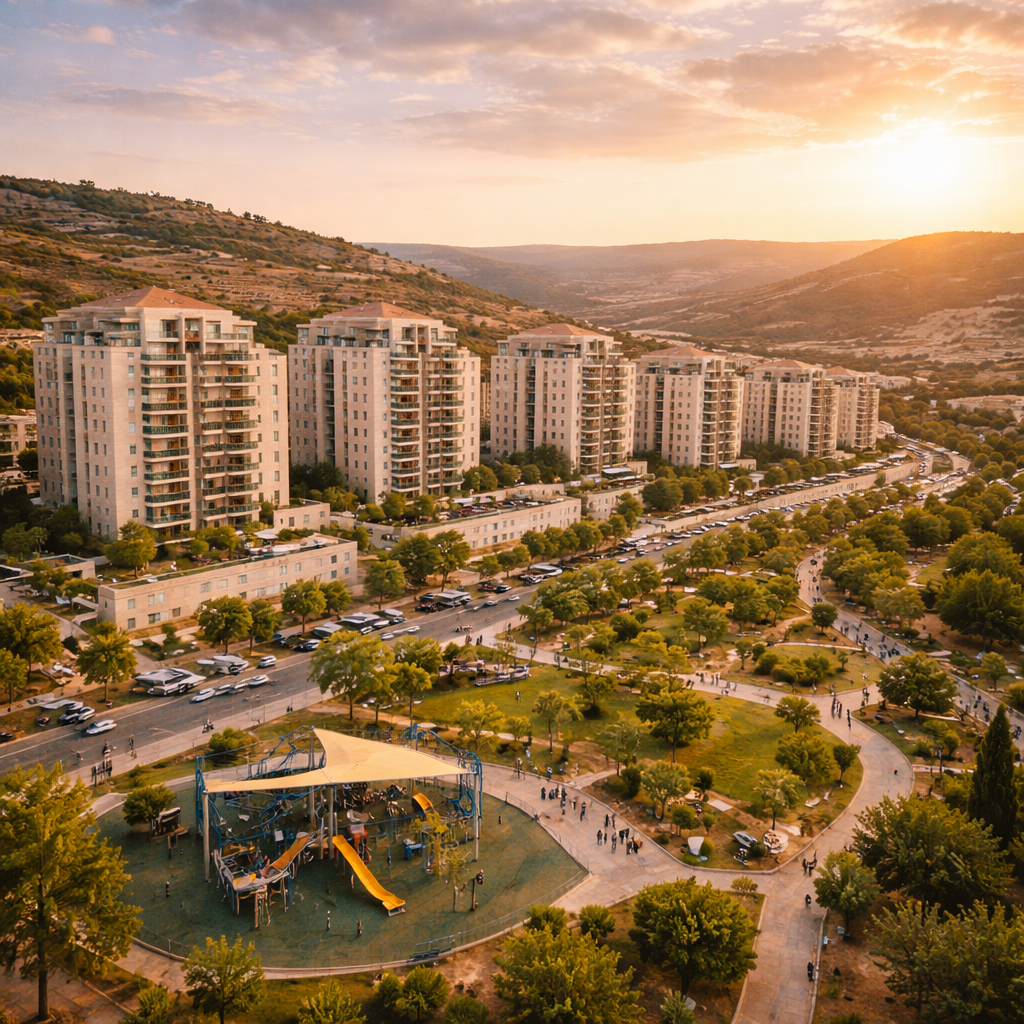
When the Israel Lands Authority released the results of a land auction on February 6th, 2012, few could have predicted that the quiet hillside overlooking the Zanoah quarry at the eastern edge of Ramat Beit Shemesh Aleph would transform within a decade into one of the most sought-after neighborhoods for Anglo families in all of Israel. That parcel of land became Mishkafayim, whose very name means “binoculars” or “perspectives” in Hebrew, a fitting description for a neighborhood perched on elevated terrain with gorgeous mountain views stretching across the Judean hills. The story of Mishkafayim is the story of modern Israel’s remarkable construction boom intersecting with the continuing wave of Anglo aliyah, creating in just a few years a leafy suburb that combines spacious modern living with strong communal institutions and a distinctly Dati Leumi character.
Mishkafayim occupies a prime location at the eastern edge of Ramat Beit Shemesh Aleph, bordered by Nahar Hayarden street on the west side and Route 10, also known as Road 3855, on the east side. This positioning gives the neighborhood easy access to the main roads while maintaining a sense of separation from the busier parts of RBS Aleph. The neighborhood is also sometimes referred to as Ramat HaRoeh, another name that emphasizes its elevated vantage point and sweeping views. Residents can enter Mishkafayim via two main access points, one from Nehar HaYarkon and another from Nehar HaYarden in Ramat Beit Shemesh Aleph, providing convenient connectivity to the established areas of the city.
The proximity to Route 375 and the Beit Shemesh city center makes commuting straightforward, whether for work, school, or leisure. Like all of Ramat Beit Shemesh, Mishkafayim benefits from being centrally located, less than an hour from both Jerusalem to the east and Tel Aviv to the west. The train from Beit Shemesh to Tel Aviv takes about half an hour, and buses to Jerusalem run approximately every ten to fifteen minutes depending on the time of day and specific location. This dual accessibility to Israel’s two major employment centers has been crucial to attracting professional families who work in high-tech, medicine, education, finance, and other fields.
Construction in Mishkafayim officially began in January 2015, marking the neighborhood as one of the recent expansions to Ramat Beit Shemesh Aleph following earlier developments like Ramat Shilo in 2007 and the M3 area. The project involved ten different developers who built various apartment complexes, creating diversity in the housing stock while maintaining an overall coherence in the neighborhood’s character. Chazon Galili was one of the first projects completed, establishing the template for what would follow. Yigal Realty arranged the buyers group for the Nofei Kedem development, which featured semi-detached homes along with duplex and penthouse apartments. The popular Sungate development by Eitz Hashaked, marketed by Yigal Realty, sold out quickly, demonstrating the strong demand for housing in this location.
Residents started moving into Mishkafayim in 2017, and the population continued to grow through 2020 as different projects reached completion. This staggered timeline meant that early residents had the experience of being pioneers, watching their neighborhood come to life around them as buildings were finished, landscaping installed, and community institutions established. By 2025, Mishkafayim is a fully developed neighborhood, though construction continues at the edges. The Dona contracting company is building a new project of 150 apartments at the entrance to Mishkafayim, ensuring that the neighborhood will continue to grow and welcome new families.
The housing stock in Mishkafayim consists almost exclusively of apartments in mid-rise buildings, typically six to nine stories high, all built within the last decade. The neighborhood was designed with families in mind, so there are very few small apartments. The focus is squarely on space and functionality. Four-room apartments, meaning three bedrooms, are the smallest standard units in the neighborhood, generally ranging from 100 to 115 square meters. These provide ample space for young families or those wanting extra room for home offices or guests.
Five-room apartments, with four bedrooms, are the most common configuration in Mishkafayim, typically ranging from 115 to 140 square meters. These represent the sweet spot for families with three or four children, offering enough space for everyone without the premium pricing of larger units. Six-room apartments and larger, with five or more bedrooms, are also available, generally ranging from 140 to 180 square meters or more. These larger units appeal to families with many children or those wanting significant extra space, though they command correspondingly higher prices.
Beyond standard apartments, Mishkafayim includes semi-detached homes and duplexes, particularly in the Nofei Kedem development and on HaRav Kook Street, where spacious cottages offer a more suburban feel. There are also penthouses in various buildings, typically featuring large outdoor terraces that capitalize on the neighborhood’s elevated position and mountain views. Additionally, the neighborhood includes a Bneh Beitcha section where individual owners are constructing private homes on large detached and semi-detached plots, adding further diversity to the housing options.
Nearly all apartments in Mishkafayim come with modern amenities that have become standard in newer Israeli construction but were often missing in earlier neighborhoods. These include a sun balcony, known in Hebrew as mirpeset shemesh, which allows families to use their sukkahs and enjoy outdoor space year-round. Most units feature a master bedroom suite with an en-suite bathroom, central air conditioning throughout the apartment, and at least one private parking spot, addressing a major pain point in older neighborhoods where parking can be scarce. Some of the newer and larger projects, like Emerald Heights, offer luxury apartments with premium finishes and expanded amenities.
As of late 2025, property prices in Mishkafayim reflect the neighborhood’s high desirability and modern construction. The market is competitive, with prices having risen substantially since the first apartments were sold. Four-room apartments typically start around 3.5 to 4 million shekels, five-room apartments range from 4 to 5.5 million shekels, and six-room apartments and larger can reach 6 million shekels or more. Semi-detached homes and large cottages command premium prices, often ranging from 6 to 12 million shekels depending on size and specific features. These price points are among the highest in Beit Shemesh, reflecting Mishkafayim’s status as a newer, more upscale neighborhood, though still more affordable than comparable housing in Jerusalem or Tel Aviv.
The community character of Mishkafayim is predominantly Dati Leumi Torani, meaning religious Zionist with a strong emphasis on Torah learning. This puts the neighborhood in a similar religious camp to parts of Sheinfeld and Nofei Aviv, though with a newer physical infrastructure. The population is a mix of Israeli and Anglo families, with a significant Anglo presence that makes English-speaking newcomers feel welcome while still providing ample opportunity to integrate into Hebrew-speaking society. The neighborhood has developed a reputation as a place where professional families who value both serious Torah learning and secular education can build lives that integrate both worlds.
The neighborhood is centered around several large, well-maintained parks that serve as gathering places for families and children. These green spaces, known in Hebrew as ganim, are a defining feature of Mishkafayim’s landscape and contribute to the suburban feel that distinguishes it from denser urban environments. Parents often congregate in these parks after school and on Shabbat, creating natural opportunities for community building and friendship formation. The emphasis on outdoor space and family-friendly design has made Mishkafayim particularly attractive to families with young children.
The synagogue scene in Mishkafayim reflects the neighborhood’s Dati Leumi orientation while also including diversity to serve different tastes and preferences. Nishmas Mishkafayim is described as a warm and welcoming Modern Orthodox synagogue that serves as a central address for the community. There is also a Beit Chabad presence in the neighborhood under the leadership of Rabbi Amos Azizoff on Harav Mordechai Eliyahu Street, providing outreach and programming for those connected to Chabad-Lubavitch. These synagogues, along with others that have developed as the neighborhood has grown, offer multiple daily minyanim and Torah classes for both men and women.
One of the most significant communal developments in Mishkafayim is Ganei HaEla, a planned community within the larger neighborhood that represents an innovative approach to community building in Israel. Ganei HaEla was conceived not by a developer looking to market apartments, but by families who shared a clear vision of communal values and then found a location and builder to match that vision. The project began with two neighbors, Rabbi Dovid Gottlieb and Yehuda Fulda, who both made aliyah from the United States and wanted to create a community that would embody specific ideals around Torah, the Jewish people, and the Land of Israel.
Rabbi Dovid Gottlieb brought impressive credentials and vision to this project. Before making aliyah in August 2010, he served as rabbi of Congregation Shomrei Emunah in Baltimore, one of the flagship Modern Orthodox synagogues in America. He received his rabbinic ordination from Yeshiva University’s RIETS, where he was also a member of the prestigious Wexner Kollel Elyon. Since arriving in Israel, Rabbi Gottlieb has served as a Ram at Yeshivat Har Etzion, one of the premier hesder yeshivot in Israel, teaching hundreds of students over the years. He is also the author of Ateret Yaakov, a book of in-depth halachic essays, and more recently Ve-Ha’Er Einenu, a multi-volume collection of essays on the weekly Torah portion distributed to soldiers throughout the IDF. Additionally, Rabbi Gottlieb serves as director of Tzalash, an organization dedicated to helping religious soldiers maintain their religious commitment and emotional well-being during their IDF service.
Ganei HaEla, whose name refers to the Valley of Elah where David fought Goliath as recorded in the book of Samuel, consists of ninety-six homes geared specifically toward Dati Leumi Torani and Modern Orthodox Jews. The community is located within the larger Mishkafayim neighborhood, sometimes specifically identified with the adjacent M3 or Givat Shilo area. What distinguishes Ganei HaEla is its intentional community structure centered around Kehillat HaEla, the central synagogue led by Rabbi Gottlieb. Unlike many Israeli neighborhoods where synagogues develop organically and separately, Ganei HaEla was planned from the beginning to have one central beit knesset that would serve as the heart and soul of the community.
Rabbi Gottlieb has explained that this communal structure, with a combined focus on tefillah, Torah study, youth programming, and social activities, is critical especially for olim who face common challenges in a new country and culture. While many communities in the Diaspora can boast of having such dynamic synagogues with engaged rabbinic leadership, this is not a common reality in Israel, where most neighborhoods have multiple small shuls rather than central community institutions. Ganei HaEla aims to recreate the best elements of American synagogue community life while being rooted in the reality of living in Israel.
The over forty families who joined Ganei HaEla in its early years represent a cross-section of backgrounds, blending recent olim from North America with English and Hebrew-speaking families already living in greater Beit Shemesh and throughout Israel. The community attracted professionals including doctors, accountants, educators, and financial analysts, ranging in age from their late twenties to their forties. These families were drawn by the clear articulation of community values around Torah-centrism, commitment to the Land of Israel and the Jewish people, and the promise of a supportive environment for raising children with these ideals.
Marketing for Ganei HaEla was handled by Shelly Levine of Tivuch Shelly, the same real estate agent who had pioneered Anglo development in Beit Shemesh by convincing developer Arie Sheinfeld to target English-speaking families in the early 1990s. Levine’s involvement brought credibility and expertise, and she noted that Ganei HaEla aimed to take Beit Shemesh to the next level of most desired neighborhoods in Israel. The project offered a variety of housing options from apartments to single-family houses within a meticulously cultivated community, with the understanding that prices would only rise from their initial offering.
The process for developing Ganei HaEla was notably different from typical Israeli real estate projects. Instead of a builder identifying a location and then marketing to whoever would buy, Ganei HaEla started with a clear vision of defining values, identified a core group of families who matched that vision, and only then finalized the location and chose the builder. Rabbi Gottlieb has attributed much of the project’s early success to this emphasis on vision and values from the outset, ensuring that families joined not just because they wanted an apartment in Beit Shemesh but because they wanted to be part of a specific type of community.
While Ganei HaEla represents a distinctive planned community within Mishkafayim, the broader neighborhood shares many of its characteristics and values. Mishkafayim as a whole is known for families who prioritize quality Torah education for their children while maintaining professional careers and engagement with broader Israeli society. The schools serving the neighborhood reflect this orientation, with children attending a mix of Dati Leumi institutions in Mishkafayim itself and nearby areas of RBS Aleph. The presence of institutions like Ahavat Yisrael, a Charedi Leumi educational system with schools in RBS Aleph, provides options for families who want to blend Haredi and Religious Zionist approaches.
One aspect of Mishkafayim that residents particularly appreciate is that while it doesn’t yet have its own shopping centers, it offers a quiet, family-friendly atmosphere with parks, schools, and religious institutions within walking distance. Residents benefit from easy access to nearby commercial areas in Ramat Beit Shemesh Aleph, including the Merkaz shopping center with over 130 stores, as well as the Sheinfeld shopping center and other retail areas. This allows Mishkafayim to maintain a more residential, less commercial character while still providing convenient access to shopping, banking, and services.
Healthcare access is excellent, with all four Israeli health funds represented in Beit Shemesh. The Terem urgent care center is available in the evenings for non-emergency medical needs, and Jerusalem’s major hospitals, including Hadassah Ein Karem and Sharei Tzedek, are only thirty to forty minutes away. Looking to the future, a branch of Hadassah Medical Center is planned to open in Beit Shemesh, which will further enhance healthcare options for Mishkafayim residents.
The demographic character of Mishkafayim fits into the broader story of Ramat Beit Shemesh as Israel’s youngest city, with most residents under the age of seventeen. The neighborhood is full of young families with children, creating a vibrant, energetic atmosphere. Strollers line the parks, playgrounds are constantly occupied, and the sound of children playing in Hebrew and English fills the air. This youthful demographic means that the community is constantly growing and evolving, with new institutions and programs emerging to meet the needs of residents.
For Anglo families making aliyah or considering a move within Israel, Mishkafayim offers several compelling advantages. The modern construction means apartments come with amenities that older neighborhoods lack. The spacious layouts accommodate larger families comfortably. The strong Anglo presence provides a support network and sense of familiarity while the mixed Israeli-Anglo character ensures that children will integrate into Hebrew-speaking society. The Dati Leumi orientation means that families can maintain both Torah values and professional careers without feeling they must choose between them. And the location provides the best of both worlds: the suburban feel of spacious homes and parks combined with easy access to Jerusalem, Tel Aviv, and all that these cities offer.
The name Mishkafayim, meaning perspectives or viewpoints, has proven prophetic. From its elevated perch overlooking the Zanoah quarry and the Judean hills, residents literally have expansive views of the surrounding landscape. But the name also captures something deeper about the community’s character: a neighborhood that offers multiple perspectives on how to live a Torah life in modern Israel, a place where Anglo and Israeli perspectives meet and blend, where traditional and contemporary approaches to religious Zionism coexist, and where families can find their own perspective on what it means to build a life in Eretz Yisrael.
In recent years, as Mishkafayim and Ramat Avraham near completion and Neve Shamir and Ramat Beit Shemesh Dalet continue to develop, Mishkafayim has established itself as a mature neighborhood that newcomers aspire to join. The infrastructure is in place, the community institutions are functioning, the parks are landscaped and maintained, and a distinct neighborhood identity has emerged. Families moving to Mishkafayim today are joining something established rather than pioneering something new, though the neighborhood continues to evolve and grow.
The rapid development of Mishkafayim from empty hillside in 2012 to thriving neighborhood by 2020 reflects Israel’s remarkable construction pace, particularly in areas popular with the religious community. What took decades to build in the original Beit Shemesh of the 1950s or even in Ramat Beit Shemesh Aleph of the late 1990s now happens in just a few years. This acceleration is driven by Israel’s young demographics, the continuing influx of immigrants, and government policies that encourage housing construction in strategic areas. For the Anglo community specifically, Mishkafayim represents the latest chapter in the ongoing story of English speakers finding their place in Israeli society while maintaining their distinctive cultural and religious identity.
Looking forward, Mishkafayim seems poised to remain one of the premier addresses for Modern Orthodox and Dati Leumi Torani families in Israel. The combination of modern housing, strong community institutions, excellent location, and clear hashkafic orientation continues to attract families at all stages of life. As the first generation of Mishkafayim children grow into teenagers and young adults, the neighborhood will face the test that all communities eventually face: can it retain its founding vision and values while adapting to changing demographics and new generations? The intentional community building exemplified by Ganei HaEla and the thoughtful planning that has characterized the neighborhood’s development suggest that Mishkafayim is well-positioned to meet this challenge.
For those contemplating aliyah or looking to relocate within Israel, Mishkafayim offers a compelling option. It provides the infrastructure and amenities of a modern development, the community support and familiar culture that make absorption easier, the educational and religious institutions that allow families to raise children according to their values, and the location and connectivity that enable professional success. While prices reflect the neighborhood’s desirability, for many families the investment is worthwhile, buying not just a home but entrance into a vibrant, values-driven community in the heart of Eretz Yisrael.