Migdal Hayamim | Anglo Community
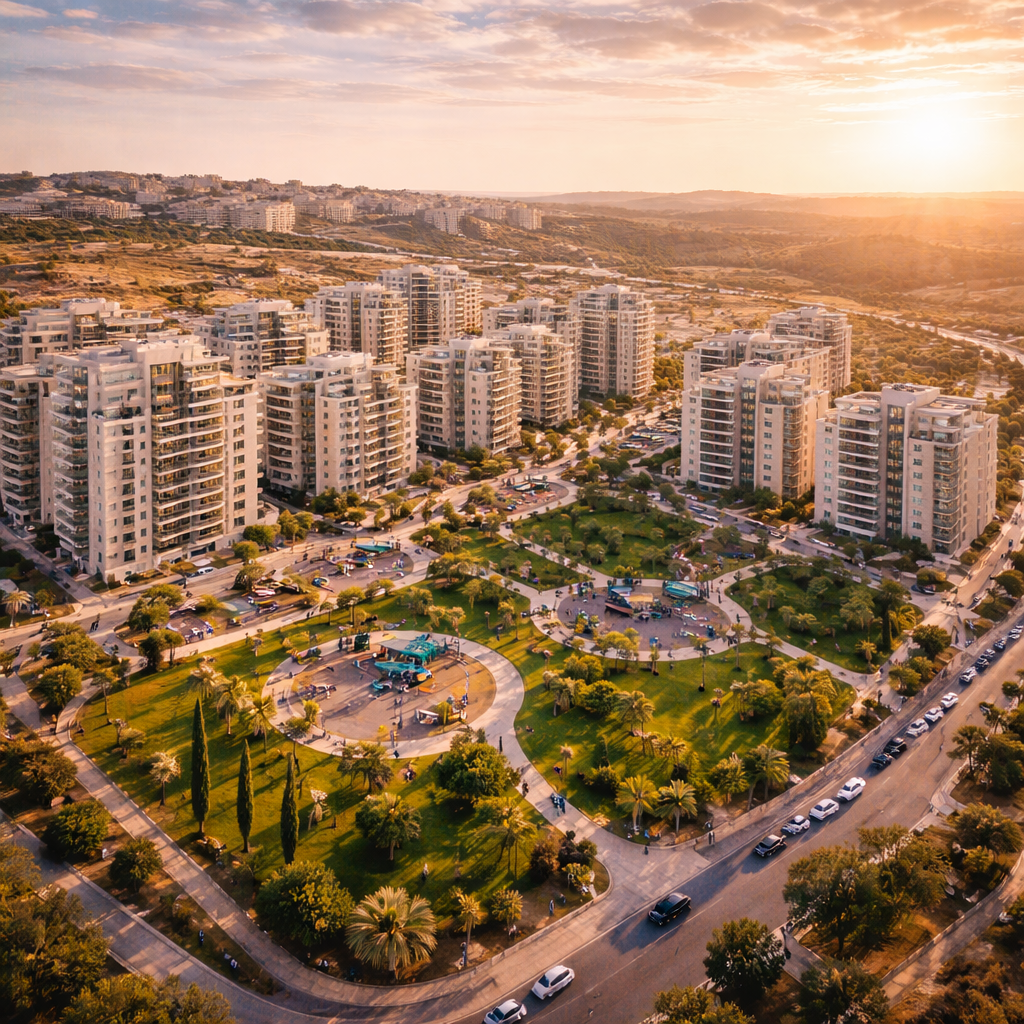
In the early 1990s, when the wave of Anglo immigration to Beit Shemesh was just beginning to build momentum, four neighborhoods in the Givat Sharett area were being developed simultaneously to accommodate the influx of English-speaking families seeking affordable housing near Jerusalem. Sheinfeld, Nofei Aviv, Nahala U’Menucha, and Migdal Hamayim all began construction during this formative period, each carving out its own identity and attracting families with different preferences and priorities. Of these four pioneering communities, Migdal Hamayim, whose name means “Tower of Water” in Hebrew, emerged as perhaps the most diverse and least exclusively Anglo, creating a unique blend of Israeli-born residents and immigrants that would distinguish it from its more homogeneous neighbors.
Migdal Hamayim was built in the Givat Sharett area of Beit Shemesh, positioned strategically between the older original Beit Shemesh established in the 1950s and the newer Ramat Beit Shemesh developments that would begin on the hills to the south later in the 1990s. This location gave the neighborhood a transitional character, neither fully part of the old development town nor quite the suburban Anglo enclave that places like Nofei Aviv would become. The neighborhood’s very name evokes the biblical history of the area, referencing the ancient water systems that sustained communities in this region for thousands of years, connecting modern residents to the deep roots of Jewish settlement in the land.
Unlike Sheinfeld and Nofei Aviv, which were explicitly marketed to Anglo families and developed with that demographic in mind, Migdal Hamayim was conceived from the beginning as a mixed neighborhood. The housing stock reflected this vision, consisting primarily of better-quality apartment blocks rather than the semi-detached cottages that characterized the wealthier Anglo areas. These apartment buildings offered a middle ground between the simple high-rise blocks of old Beit Shemesh and the premium villas of neighborhoods like Nofei Aviv, making them accessible to a broader range of families both economically and culturally.
The population of Migdal Hamayim became remarkably diverse, creating what some described as a very mixed community that reflected the broader Israeli society in microcosm. Israeli-born families from various backgrounds settled alongside immigrants from Russia, Ethiopia, English-speaking countries, and other parts of the Jewish diaspora. This diversity was unusual for Beit Shemesh in the 1990s, when most neighborhoods were trending toward religious and ethnic homogeneity, with secular Israelis concentrating in certain areas, Haredim in others, and Anglos in their own enclaves.
The religious character of Migdal Hamayim also spanned a wider spectrum than many neighboring communities. While the neighborhood was predominantly Orthodox, residents ranged from Modern Orthodox and Dati Leumi to various streams of Haredi Judaism, with some traditional or secular families mixed in as well. This religious diversity meant that multiple synagogues serving different populations emerged within the neighborhood, each catering to slightly different liturgical traditions and community styles.
One of the central institutions that developed in Migdal Hamayim was Kehilla Datit Leumit, a national religious congregation that served the Modern Orthodox and Dati Leumi population in the neighborhood. This kehilla provided a communal home for families who valued both serious Torah learning and engagement with broader Israeli society, who expected their sons to serve in the army and their daughters to pursue higher education, and who saw themselves as part of the religious Zionist stream of Judaism. The existence of this kehilla helped establish Migdal Hamayim as a viable option for Anglo families who wanted a Modern Orthodox environment without the exclusively Anglo character of neighborhoods like Sheinfeld.
The mixed nature of Migdal Hamayim meant that children growing up in the neighborhood were exposed to a broader cross-section of Israeli society than they might have been in more insular communities. Kids played together in parks and went to school together regardless of whether their parents were Israeli sabras or recent immigrants, whether they spoke Hebrew, English, Russian, or Amharic at home, whether they wore black hats or knitted kippot or no head covering at all. This exposure to diversity became one of the neighborhood’s defining characteristics, preparing children for life in the complex, multifaceted society that Israel truly is.
For Anglo families making the decision about where to settle in Beit Shemesh in the 1990s, Migdal Hamayim represented a different proposition than the other available options. Families who chose Sheinfeld or Nofei Aviv were often seeking the comfort and familiarity of living primarily among other English speakers, a soft landing that would make the difficult transition to Israeli life somewhat easier. Those who chose Migdal Hamayim were, in a sense, opting for deeper integration from the outset, accepting that they would be a minority within a mixed Israeli neighborhood rather than part of a dominant Anglo majority.
This choice came with both advantages and challenges. On the positive side, families in Migdal Hamayim integrated more quickly into Hebrew-speaking society. Their children became fluent in Hebrew faster, developed friendships with native Israeli kids, absorbed Israeli culture more thoroughly, and often had an easier time navigating systems and institutions that could baffle Anglos living in more isolated enclaves. Parents who worked in Israeli companies or organizations often found that living in a mixed neighborhood helped them understand their colleagues and the broader culture better than they might have in an exclusively Anglo setting.
The challenges, however, were also real. Without the critical mass of English speakers found in neighborhoods like Sheinfeld, Migdal Hamayim didn’t develop the same Anglo-specific infrastructure and support systems. There were fewer opportunities to speak English socially, fewer neighbors who could relate to the specific challenges of American or British immigrants, less sharing of information about navigating Israeli bureaucracy, and generally more isolation for families struggling with Hebrew or cultural adjustment. The lack of an explicitly Anglo character also meant that communal institutions didn’t necessarily cater to American expectations about things like synagogue programming, educational approaches, or community organization.
The housing in Migdal Hamayim, consisting primarily of apartment buildings rather than private homes, also reflected a different lifestyle and economic reality than the villa neighborhoods. Apartments meant less private outdoor space, shared building infrastructure, more interaction with neighbors by necessity, and a more urban living experience overall. For families coming from American suburbs where private homes with yards were the norm, this adjustment could be significant. At the same time, apartments were more affordable than houses, both to purchase and to maintain, making Migdal Hamayim accessible to families with more modest means.
The neighborhood’s location in Givat Sharett proved advantageous in many ways. It was within walking distance of Sheinfeld and Nofei Aviv, allowing residents to access the shopping centers, synagogues, and community resources of those neighborhoods while maintaining their own distinct identity. The proximity also meant that children from Migdal Hamayim often attended schools in neighboring areas, creating social networks that spanned multiple neighborhoods and exposing kids to different community environments.
In June 2023, Migdal Hamayim gained a significant new institution when the Hadassah Medical Organization opened a medical facility in the neighborhood. This development brought sophisticated medical services to Beit Shemesh for the first time, relieving residents of having to travel to Jerusalem for specialized care. The facility offers cardiology, pediatric hematology, gastroenterology, gynecological surgery, treatment of pediatric eating and feeding issues, a pain clinic, and plans to expand to include children’s psychiatry, ophthalmology, nephrology, respiratory treatment, and surgical services in two operating rooms.
The establishment of Hadassah Beit Shemesh in Migdal Hamayim was significant not just for the medical services it provided but also for what it symbolized about the neighborhood’s central location and accessibility. The choice of Migdal Hamayim for this facility reflected the area’s position as a crossroads within Beit Shemesh, easily reachable from multiple neighborhoods and serving a diverse patient population. The medical center brought jobs, infrastructure investment, and increased foot traffic to the neighborhood, subtly elevating its status within the broader Beit Shemesh landscape.
Over the years, as Beit Shemesh grew and evolved around it, Migdal Hamayim maintained its character as a mixed, diverse neighborhood even as other areas became increasingly homogeneous. While neighborhoods like RBS Aleph developed distinct sections with clear religious and ethnic identities, and while entire new neighborhoods like RBS Gimmel and Dalet were planned explicitly for Haredi populations, Migdal Hamayim remained stubbornly heterogeneous. This consistency became valuable in a city where demographic change was happening rapidly and where many residents worried about the loss of diversity.
The schools serving Migdal Hamayim reflected the neighborhood’s mixed character, with children attending a variety of institutions depending on their families’ religious orientation and educational philosophy. Some attended the Modern Orthodox schools that served the broader Dati Leumi community across Beit Shemesh, some went to Haredi institutions, and some attended schools in neighboring Sheinfeld or other areas. This dispersion meant that unlike neighborhoods with one or two dominant schools that created a unified community culture, Migdal Hamayim families were more individualized in their educational choices and the social networks that flowed from them.
For the Anglo families who did settle in Migdal Hamayim, the experience often involved more rapid assimilation than their counterparts in heavily Anglo neighborhoods might experience. Speaking Hebrew became necessary rather than optional, since many neighbors and community members didn’t speak English. Adapting to Israeli customs and expectations happened faster when you couldn’t retreat to an Anglo bubble after difficult encounters. Children’s Hebrew fluency often surpassed that of kids in Sheinfeld or Nofei Aviv, since they needed it for everyday social interaction rather than just for school.
This faster integration came at a cost, however. Some families found the experience isolating, especially in the early years when Hebrew was weak and cultural misunderstandings were frequent. The absence of a robust Anglo support network meant that information about resources, services, and solutions to common problems didn’t circulate as efficiently. New immigrants who moved to Migdal Hamayim sometimes found themselves reinventing wheels that Sheinfeld residents had already figured out, simply because there weren’t as many experienced olim around to share advice.
The diversity that characterized Migdal Hamayim also meant navigating a broader range of religious sensibilities and community expectations. In a more homogeneous neighborhood, there’s generally consensus about issues like Shabbat observance in public spaces, modest dress, the role of women in community life, and the balance between secular and religious education. In Migdal Hamayim, these issues were more contested, requiring residents to negotiate and compromise in ways that more uniform communities didn’t need to. This could be enriching, exposing families to different approaches within Orthodox Judaism, or it could be frustrating when trying to establish community norms.
The economic diversity of Migdal Hamayim, flowing from its mixed population and apartment-based housing stock, also distinguished it from wealthier neighborhoods. While places like Nofei Aviv attracted primarily middle and upper-middle class professionals, Migdal Hamayim included families across a broader economic spectrum. This meant more socioeconomic diversity in schools and synagogues, more awareness of financial struggles that some families faced, and potentially more robust chesed organizations to help those in need.
As Beit Shemesh continued its explosive growth from the mid-1990s onward, eventually becoming one of Israel’s fastest-growing cities with a population exceeding 150,000 by the 2020s, Migdal Hamayim found itself increasingly surrounded by newer, larger developments. Ramat Beit Shemesh Aleph, Gimmel, Dalet, and Neve Shamir rose on the hills around the original Givat Sharett neighborhoods, dwarfing the earlier communities in size and population. In this context, Migdal Hamayim became part of what residents sometimes called “old Beit Shemesh,” though it was barely thirty years old.
This positioning as an established neighborhood in an rapidly expanding city brought both advantages and challenges. On the positive side, Migdal Hamayim had mature infrastructure, established institutions, tree-lined streets, and a settled community feel that newer areas lacked. The apartments, while not new, were well-built and had stood the test of time. The location was central, with easy access to shopping, transportation, and all city services. For families who valued stability and establishment over cutting-edge amenities, these qualities were attractive.
On the challenging side, Migdal Hamayim sometimes struggled to compete with shinier new developments offering modern apartments with better layouts, newer appliances, and contemporary design. Young families making aliyah in the 2010s and 2020s often preferred the brand-new apartments of Mishkafayim or Neve Shamir over the twenty-year-old buildings of Migdal Hamayim, even if the older neighborhood offered better value and a more diverse community. This meant that the neighborhood’s population aged somewhat, with fewer young families replacing those who moved on.
The relationship between Migdal Hamayim and the neighboring Anglo-heavy areas of Sheinfeld and Nofei Aviv was complex and multifaceted. Residents often moved between these neighborhoods, with families sometimes starting in the more affordable Migdal Hamayim apartments and later purchasing homes in Nofei Aviv or Sheinfeld as their financial situation improved. Others moved in the opposite direction, downsizing from houses to apartments as children grew and left home. The porousness of these neighborhood boundaries meant that friendships, synagogue memberships, and school communities often crossed geographical lines.
Looking back over three decades since Migdal Hamayim’s founding, the neighborhood’s choice to embrace diversity rather than seeking homogeneity represents an important counterpoint to the broader trends in Beit Shemesh and religious Israeli society generally. At a time when increasing segmentation by religiosity, ethnicity, and economic status has characterized much of Israeli development, Migdal Hamayim demonstrated that mixed communities could work, that diversity could be a strength rather than a problem, and that integration across communal boundaries was possible even within the Orthodox world.
For the families who made Migdal Hamayim their home, the neighborhood offered something that more segregated communities couldn’t: exposure to the full complexity and richness of Israeli Jewish life. Living among Ashkenazim and Sephardim, Haredim and Dati Leumi, native Israelis and immigrants from six continents, provided an education in pluralism that would serve children well as they grew into Israeli adults navigating a diverse society. The friendships formed across these dividing lines, the understanding developed of different Jewish traditions and perspectives, and the ability to communicate and cooperate with people from very different backgrounds became valuable life skills.
Today, Migdal Hamayim continues to serve its role as a mixed, accessible, centrally located neighborhood in the heart of Beit Shemesh. It may not have the cachet of newer developments or the exclusively Anglo character of Sheinfeld, but it offers something equally valuable: an authentic Israeli community experience where diversity is the norm and integration is not just encouraged but inevitable. For Anglo families seeking not just to live in Israel but to truly become part of Israeli society, Migdal Hamayim provided and continues to provide a path forward, even if it’s a more challenging path than the soft landing of purely Anglo neighborhoods. In its own quiet way, Migdal Hamayim represents an important strand in the story of Anglo aliyah to Beit Shemesh, one that chose integration over insularity and diversity over homogeneity.