Ramat Tzvi | Anglo Community
When you navigate through Zichron Yaakov, following the roundabouts that mark transitions from one section of town to another, you’ll encounter signs pointing toward Ramat Tzvi and the adjacent Mul HaYekev area. The roundabout that marks this turn is known locally as Charenton le Pont Square, a curiously French name that hints at Zichron’s historical connections to Baron Rothschild’s France. Ramat Tzvi sits close to the center of the Moshava, within walking distance of the Pisgat Zichron shopping center and the commercial heart of this historic wine country town, yet it maintains a distinct character that sets it apart from both the tourist-oriented pedestrian mall and the more secular neighborhoods that define much of Zichron’s identity.
The neighborhood’s name, Ramat Tzvi, carries multiple possible meanings in Hebrew. Ramat typically means “heights” or “plateau,” while Tzvi can mean “deer” or be a common given name. Whether it refers to the heights of some individual named Tzvi or to the plateau of the deer, the name suggests elevation and grace. What’s certain is that Ramat Tzvi has become synonymous with something specific in Zichron Yaakov’s social and religious geography. This is one of two neighborhoods in the town, along with Hazon Ish, that has developed a Haredi population including a significant number of English-speaking families.
Understanding Ramat Tzvi requires understanding what makes Zichron Yaakov unusual among Israeli towns. While the majority of the town’s citizens would define themselves as secular, Zichron has cultivated something relatively rare in Israel: genuine religious pluralism and coexistence. The same town that houses members of the Ohr Yaakov Yeshiva and a Chabad community that built a replica of 770 Eastern Parkway also has Progressive and Conservative synagogues alongside multiple religious Zionist congregations. Old-timers who comprise the agricultural community live alongside National Religious families, Haredim, Yemenites, Sephardim, and waves of new immigrants from around the world. Since the COVID period, there’s been a particular increase in Anglos, with many immigrants from California drawn to Zichron’s mountain location close to the sea, finding it somewhat similar to their previous surroundings.
Within this diverse tapestry, Ramat Tzvi has emerged as a destination specifically for Haredi English-speaking immigrants. Community guides for new arrivals consistently direct Charedi Anglo immigrants toward neighborhoods mostly near or on Derech Sarah, Hazon Ish, and Ramat Tzvi. This clustering creates the infrastructure that makes Orthodox Jewish life manageable and fulfilling: multiple synagogues within walking distance, educational options for children across age ranges, shopping that understands kashrut needs, and perhaps most importantly, a critical mass of like-minded families creating a social support network.
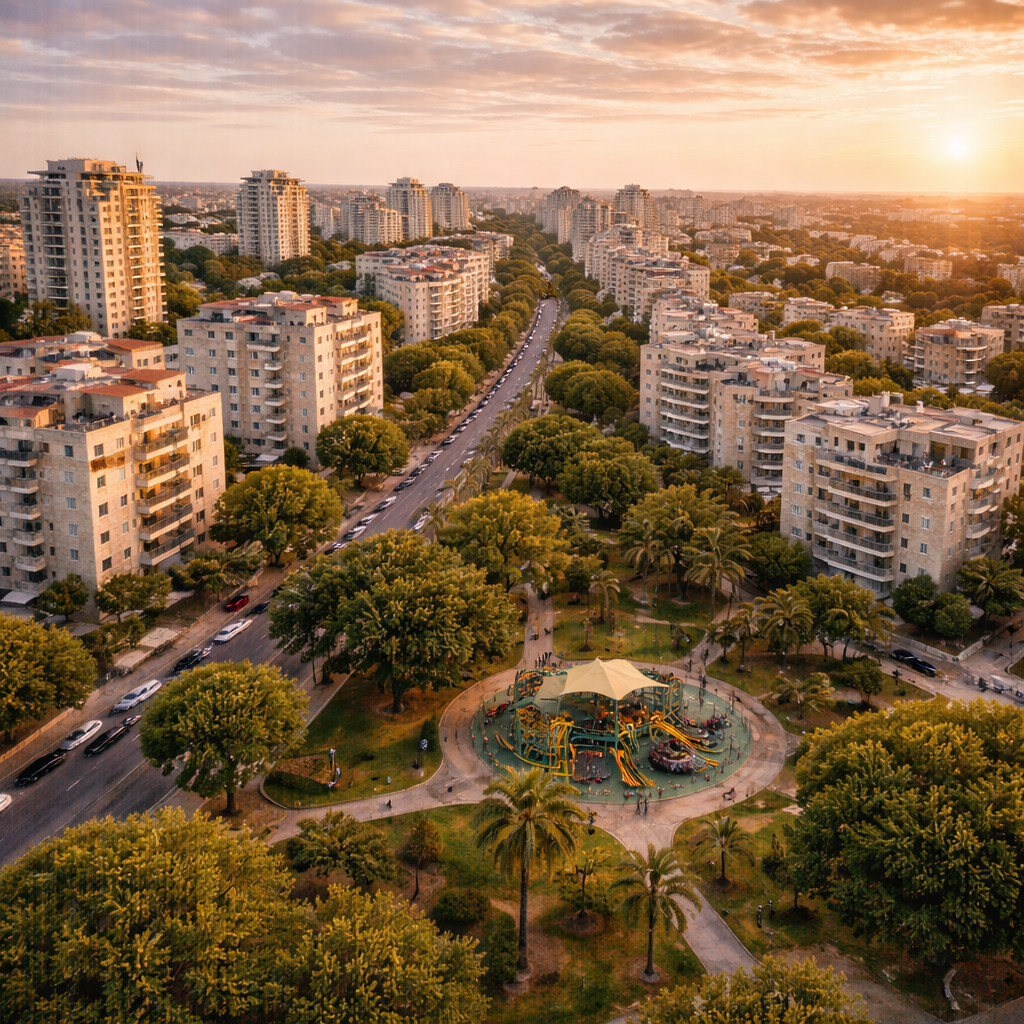
The physical layout of Ramat Tzvi reflects a particular planning approach. The neighborhood consists of an outer ring of apartment buildings that encircle an inner ring of multi-family houses. This creates a kind of protective structure where the apartments form a perimeter while the houses nestle within, fostering a sense of enclosure and community cohesion. A short walk connects residents to a local shopping center, health clinics, parks, and what descriptions emphasize as “a multitude of synagogues,” making it an attractive destination for families who want religious amenities readily accessible without depending entirely on cars.
For many years, Ramat Tzvi maintained a relatively homogeneous population with a large component of Haredi families who had settled there precisely because of this religious infrastructure and the presence of other families sharing their lifestyle and values. The streets had that particular quality that develops in neighborhoods built around shared religious practice: you’d see children walking to yeshiva or Beit Yaakov schools, families heading to multiple minyanim throughout the day, and the rhythm of Shabbat defining the week’s tempo more visibly than in mixed neighborhoods.
Then came TAMA 38, the national building reinforcement and renovation program that has transformed neighborhoods across Israel. TAMA 38, whose name comes from the Hebrew acronym for National Outline Plan 38, was designed to strengthen existing buildings against earthquakes, a serious concern in Israel. The program offers a unique deal: building owners get their structures reinforced and modernized, often with additional floors or units added, without paying for the work themselves. Developers cover the costs in exchange for the right to sell or rent the newly created apartments. The program has proven enormously attractive because it addresses Israel’s chronic housing shortage while simultaneously making older buildings safer and more valuable.
In Ramat Tzvi, multiple buildings have undergone or are undergoing these TAMA 38 renovations. The old tenement buildings that housed the neighborhood’s original Haredi residents have been transformed into modern apartment buildings with spacious apartments, improved infrastructure, green parks, regulated parking areas, and contemporary amenities. Two-story semi-detached houses have appeared alongside the renovated apartment buildings. The physical transformation is dramatic: where weathered concrete once dominated, now stand structures with contemporary facades, better insulation, proper parking, and the kind of finishes that appeal to a broader demographic.
This physical renewal has brought demographic change. A more diverse population has been moving into the outlying areas of Ramat Tzvi, particularly into these newly renovated TAMA 38 buildings. The neighborhood that once had a large component specifically of Haredi families now describes itself as completely mixed, with old-timers and newcomers, secular and religious, creating what some describe as a peaceful neighborhood charm all its own. This mixing doesn’t mean the neighborhood has lost its Haredi character entirely, rather that it has become less homogeneous, more representative of Zichron’s overall diversity.
The presence of a few small shops and health clinics scattered through the neighborhood, combined with the mostly freestanding or attached houses in certain sections, gives Ramat Tzvi the feel of being slightly off the beaten path despite its proximity to central Zichron. It’s quiet in a way that appeals to people looking for residential tranquility rather than the bustle of the tourist areas. You won’t find the cafes and boutiques that line HaMeyasdim Street. Instead, you find the infrastructure of daily life: the corner grocery, the health clinic, the kindergartens, the neighborhood synagogues where the same faces appear day after day.
For English-speaking Haredi families considering Zichron Yaakov, Ramat Tzvi offers several advantages. The neighborhood is close enough to the Moshava to access the historic Ohel Yaakov synagogue and other central amenities, yet maintains its own distinct religious character. The presence of both a Yeshiva Ketana and Yeshiva Gedola for boys in Zichron, along with a small local girls’ seminary, means families can keep their children in town for at least part of their education, though many high-school girls do commute to Beit Yaakov schools in Haifa and Hadera for more options.
The educational infrastructure matters enormously for Haredi families. Unlike Modern Orthodox families who might choose schools across the religious spectrum, Haredi families need specifically Haredi educational options that maintain their community’s approach to Torah study, secular education, and gender separation. Zichron offers some of these options locally, with the understanding that for the full range, families may need to utilize the relatively good public transportation connections to Haifa and Hadera, or arrange carpools with other families doing the same commute.
One of the appeals that Zichron generally, and neighborhoods like Ramat Tzvi specifically, holds for English-speaking immigrants is the welcoming nature of the community. Multiple sources emphasize that immigrants feel a sense of fitting into the community almost immediately upon arrival. This is particularly valuable for Haredi families making aliyah, who often face challenges integrating into Israeli Haredi society that has its own cultural patterns, linguistic preferences, and social hierarchies. An Anglo Haredi community within Ramat Tzvi creates a bridge, offering familiarity of language and cultural reference points while navigating the transition to Israeli life.
The Ohr Yaakov Yeshiva plays a significant role in the Haredi infrastructure of Zichron. The yeshiva’s presence means there’s a steady population of young men learning full-time, creating demand for apartments, supporting local businesses that serve the religious community, and contributing to the density of Torah study that Haredi communities value. The Chabad community, with its replica of 770 Eastern Parkway that serves as a local landmark, adds another dimension to the town’s religious infrastructure, offering programming, outreach, and the particular warmth and inclusiveness that Chabad houses are known for providing.
The question of affordability has always been complex in Zichron. The town’s beauty, its historic significance, its wine country appeal to tourists, and its proximity to both Haifa and the coast have kept real estate values relatively high compared to development towns in the periphery. However, Ramat Tzvi, particularly before the TAMA 38 renovations transformed much of its housing stock, offered more accessible price points than some of Zichron’s premium neighborhoods. The older apartment buildings that attracted the initial Haredi residents were more affordable than new construction or the historic properties near the Moshava center.
The TAMA 38 transformation creates a complex dynamic. On one hand, the renovated buildings offer vastly improved living conditions: better construction, modern amenities, additional space in some cases, and the peace of mind that comes from earthquake-resistant structures. On the other hand, the renovations typically come with increased rental rates or purchase prices as owners and developers seek returns on the investment. The new apartments attracting a more diverse, often more affluent population can shift the neighborhood’s character and potentially price out some of the families who gave Ramat Tzvi its original identity.
This tension between preservation of community character and the benefits of physical renewal plays out across Israel, but it has particular poignancy in Haredi neighborhoods where the community’s cohesion depends on critical mass. If too many families are displaced by rising costs or if the influx of new residents shifts the religious character significantly, the neighborhood can lose the very qualities that made it attractive to Haredi families in the first place. The multitude of synagogues matter less if they struggle to make minyanim because families have moved away. The religious schools face challenges if enrollment drops.
Yet there’s also opportunity in the mixing. Zichron’s strength has always been its ability to maintain diverse communities living side by side with mutual respect. The town’s uniqueness in having Reform, Conservative, Modern Orthodox, and Haredi communities all functioning within the same municipality demonstrates that coexistence is possible when there’s goodwill and adequate infrastructure for each community’s needs. Ramat Tzvi’s evolution toward becoming a more mixed neighborhood while retaining significant Haredi presence could represent a healthy balance rather than a loss of identity.
The neighborhood’s location close to the center of the Moshava means that residents aren’t isolated despite the religious focus. The secular educational institutions, from preschools through high school, are accessible for families across the religious spectrum. The community center with its programs for youth and adults creates opportunities for interaction across community lines. The public library, parks, and museums that make Zichron culturally rich are within reach. Even the proximity to the Pisgat Zichron shopping mall and other commercial centers means that while Ramat Tzvi can feel like a quiet residential enclave, it’s embedded in a functioning, diverse town rather than being a segregated settlement.
The municipal government’s provision of information in English, including an English-speaking Aliyah coordinator, reflects an awareness that English-speaking immigrants are a significant and growing part of Zichron’s population. This infrastructure benefits Ramat Tzvi’s Anglo Haredi residents who need help navigating Israeli bureaucracy, understanding municipal services, accessing Hebrew language education, and connecting with community resources. The municipality’s website offers information specifically aimed at Anglo immigrants, recognizing that even with the best intentions, the transition to life in Israel involves countless practical challenges that are easier to navigate with guidance in one’s native language.
Living in Ramat Tzvi today means being part of a neighborhood in transition. The physical transformation from older, sometimes cramped apartments into modern, spacious units represents one kind of change. The demographic mixing of traditional Haredi residents with newcomers from different religious and cultural backgrounds represents another. The balance between maintaining the religious character that drew Haredi families to the neighborhood and embracing the diversity that makes Zichron special requires ongoing negotiation and goodwill from all sides.
For a Haredi English-speaking family considering Ramat Tzvi, the calculation involves weighing several factors. The neighborhood offers proximity to religious infrastructure including multiple synagogues, access to some local Haredi educational options with additional choices in nearby cities, a community of English-speaking Haredi families creating social support, and relatively close proximity to the town center without being in the tourist zone. The TAMA 38 renovations mean that housing stock is being upgraded, potentially offering better living conditions than older unrenovated apartments elsewhere.
At the same time, families need to understand that Ramat Tzvi is not a Haredi-only neighborhood, nor is Zichron Yaakov a Haredi town. The religious pluralism and diversity that characterize Zichron mean that children will encounter secular Israelis, Reform and Conservative Jews, and the full spectrum of Israeli society. For some Haredi families, this exposure is welcome, even desirable, as they seek to raise children who are anchored in Torah values while also comfortable navigating the broader Israeli society. For others who prefer a more insular environment where children primarily interact with others from similar backgrounds, Ramat Tzvi’s increasing diversity might be less appealing than more uniformly Haredi neighborhoods in places like Bnei Brak, Beitar Illit, or certain sections of Jerusalem.
The question of where to send teenage daughters to school often becomes a deciding factor for Haredi families. The need to commute to Beit Yaakov schools in Haifa or Hadera isn’t necessarily prohibitive, many families in smaller communities manage these commutes, but it does add complexity to daily life. Parents need to arrange transportation, whether through public buses, shared taxis, or carpools with other families. The time spent commuting is time taken from study or family life. These practical realities shape whether families find Ramat Tzvi sustainable for the long term or whether they eventually migrate toward larger Haredi population centers where everything is more readily accessible.
What makes Ramat Tzvi and Zichron Yaakov more broadly appealing despite these challenges is the overall quality of life the town offers. The beautiful views across the Coastal Plain to the Mediterranean, the clean air on the heights of Mount Carmel, the sense of history walking through streets that the First Aliyah pioneers established, the cultural richness of the museums and wineries, the natural beauty of the Ramat HaNadiv nature reserve just south of town all contribute to a living environment that feels special. For families who want their children raised with both strong Torah education and exposure to the beauty of the land of Israel, to history, to nature, Zichron offers a compelling combination.
The challenge and the promise of Ramat Tzvi lie in whether it can successfully navigate its transformation while serving the needs of diverse populations. Can the neighborhood absorb new residents from TAMA 38 developments while maintaining enough Haredi presence to sustain the religious infrastructure? Can longtime residents and newcomers find ways to coexist that respect different lifestyle choices and needs? Can the municipality support the neighborhood through infrastructure investments, sensitive planning, and community programming that builds bridges rather than walls?
These questions don’t have simple answers, but the fact that Ramat Tzvi continues to attract Haredi English-speaking families even amid its transformation suggests that many people believe the neighborhood’s strengths outweigh its complexities. The combination of religious infrastructure, community support, improved housing through TAMA 38, proximity to town amenities, and the overall Zichron quality of life creates a package that works for families willing to embrace some degree of diversity while maintaining their commitment to Haredi practice and values. The neighborhood’s future will depend on whether this balance can be sustained as physical renewal continues and the population continues to evolve.