Kaiser | Anglo Community
Imagine a neighborhood where your children play soccer in Hebrew with Israeli kids in the afternoon, but come home for Shabbat dinner with families from Manchester and Johannesburg. Where you can walk to thirteen different synagogues, including the beloved “Anglo shul” that feels like a slice of Teaneck transplanted to the Israeli landscape. Where low-rise buildings create an almost suburban feel, yet everything you need is within a ten-minute walk. Welcome to Kaiser—or as it’s officially known in Hebrew, Avnei Chen. This is Modiin’s hidden gem, the neighborhood that offers something increasingly rare in Israel’s Anglo communities: genuine integration without isolation. While Buchman gets more attention as Modiin’s premier Anglo destination, many families who’ve explored both will tell you that Kaiser offers something special—a true 50/50 blend of Anglo and Israeli families that creates not just a place to live, but a model for how aliyah can work at its best. Today, we’re going to explore Kaiser in depth—its unique character, its family-friendly design, its vibrant community life, and why it might be the perfect choice for families who want to be fully Israeli while keeping their Anglo identity intact.
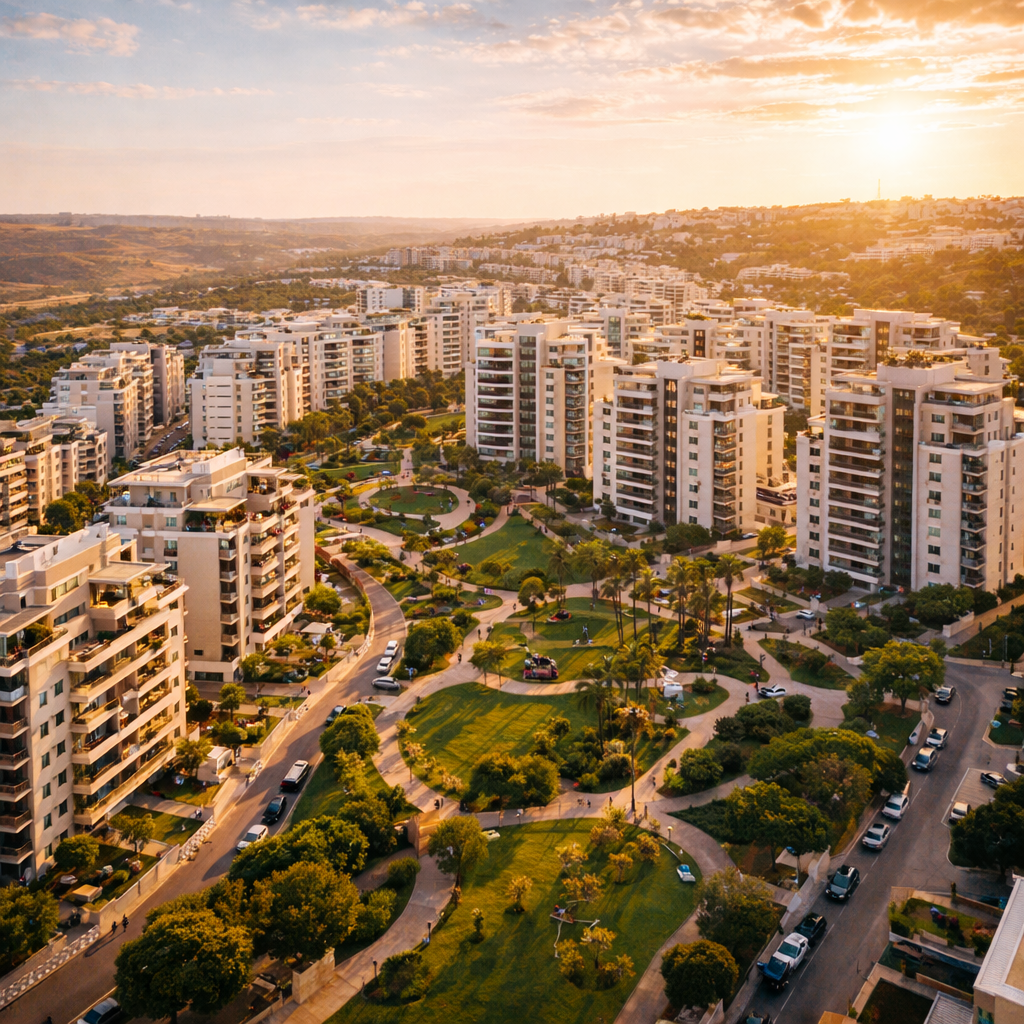
Kaiser’s story is one of intentional community building, though perhaps not in the way the original planners envisioned. The neighborhood was developed in the mid-to-late 2000s as part of Modiin’s expansion. Unlike some Israeli neighborhoods that seem to spring up overnight in a chaotic rush, Kaiser was carefully planned. The emphasis was on creating a residential area that would feel livable—low-rise buildings, mostly four to five stories, wide streets, plenty of green spaces, and a walkable layout where families could access essential services without needing a car for every errand.
What makes Kaiser unique is how it evolved. While neighborhoods sometimes become Anglo enclaves almost by accident—one family moves in, tells their friends, and suddenly there’s a concentration—Kaiser developed more organically. Israeli families were drawn by the quality of life, the modern apartments, and the family-friendly design. Anglo families were attracted by the same features, plus the growing reputation of excellent religious infrastructure and English-speaking community. The result? A genuine mixed neighborhood where, as one resident from London put it, “Kaiser gave us Israeli immersion without losing our Anglo identity.”
This 50/50 balance is remarkable and rare. In many Anglo neighborhoods, you hit a tipping point where the concentration becomes so heavy that it’s essentially an Anglo enclave with some Israeli neighbors. In others, Anglos are so dispersed that they struggle to find community. Kaiser threads the needle—there are enough Anglo families to create strong support networks, English-language shiurim, and that crucial feeling of “you’re not alone in this aliyah journey.” But there are also enough Israeli families that your kids are speaking Hebrew on the playground, you’re invited to Israeli neighbors’ simchas, and you’re truly living in Israeli society, not alongside it. By the early 2020s, Kaiser had established itself as one of Modiin’s most desirable neighborhoods, particularly for religious families. The infrastructure was mature, the community was thriving, and word was spreading through the Anglo olim networks: if you want the best of both worlds, look at Kaiser.
Let me take you on a walking tour of Kaiser, because understanding the physical environment helps explain why families love it here. You enter Kaiser and immediately notice the scale. Unlike some Israeli neighborhoods with towering apartment blocks that can feel impersonal and dense, Kaiser is built on a human scale. Most buildings are four to five stories—tall enough to be efficient but low enough to maintain a neighborhood feel. There’s sky visible, there’s breathing room, and it doesn’t feel like you’re living in an urban canyon. The streets are wide and well-planned. Traffic flows but it’s not overwhelming. Crucially, the traffic moves relatively slowly—this is a neighborhood designed for families with children, and you can feel it. Parents let their kids bike around the neighborhood with more confidence than they might in some other areas.
Green spaces are everywhere. Small parks dot the neighborhood—nothing massive, but perfect for the playground crowd. There are trees lining the streets, creating shade in the brutal Israeli summer. There are benches where you’ll see older residents sitting and chatting, or parents watching their kids play. The walkability score is remarkable—85 out of 100, meaning virtually everything essential is within a comfortable ten-minute walk. Speaking of walking, let’s see where we’d go. Within Kaiser itself, you’ll find multiple small commercial areas. There are makolets for quick shopping, a pharmacy, small cafes, pizza shops, and those essential services you need regularly. For larger shopping, you’re a short walk or drive to bigger commercial centers in Modiin.
But what really defines Kaiser physically are the synagogues. Thirteen of them, representing different styles, different communities, different nuschaot. There’s the famous Darchei Tzion, known as the “Anglo shul,” where you’ll hear English announcements and where American-style hashkafa predominates. But there are also Sephardic shuls, Israeli Ashkenazi shuls, more yeshivish options, and more modern Orthodox choices. On Friday night and Shabbat morning, you’ll see families walking to different shuls, creating this beautiful tapestry of religious diversity all within one neighborhood.
The schools are integrated into the neighborhood as well. Darchei Yehuda, the local religious school, has earned a strong reputation and includes many Anglo children, which means your kids aren’t the only new immigrants in their class. The school has experience with English-speaking children and knows how to support them through the Hebrew language learning process. The architecture is standard Israeli modern—clean lines, practical layouts, the familiar Israeli apartment style. Most apartments have balconies, essential for succot, many have mamads or safe rooms, and the construction quality is generally good. These aren’t luxury apartments, but they’re solid, functional, and well-maintained. Many buildings have elevator access, though not all, so that’s something to check if mobility is a concern.
One unique feature residents appreciate: the quiet. Despite being well-populated, Kaiser doesn’t have the noise levels of some neighborhoods. Partly this is the low-rise design—less density means less noise. Partly it’s the family demographic—this is not a neighborhood of bars and nightlife. It’s a place where families settle in for the long term, and that creates a certain peaceful rhythm to daily life.
Now let’s talk about what really makes Kaiser special: the community. That 50/50 Anglo-Israeli mix I mentioned earlier isn’t just a demographic statistic—it’s the defining feature of daily life here. And it creates something quite special. For Anglo families, especially in the first years after aliyah, there’s enormous comfort in having English-speaking neighbors. The WhatsApp groups—”Kaiser Anglos,” “Kaiser Moms,” “Kaiser Recommendations”—are lifelines. Someone needs a babysitter who speaks English? Posted and answered within minutes. You’re confused about how to pay your arnona? Three different people explain it. Your kid is struggling with Hebrew at school? Parents who’ve been through it share strategies and recommend tutors.
But here’s where Kaiser differs from more heavily Anglo neighborhoods: you’re not living in a bubble. Your downstairs neighbors might be sabras from Haifa. The family your kids play with after school might speak only Hebrew at home. The woman you chat with at the pharmacy might be a Moroccan-Israeli grandmother who’s lived in Modiin since it was founded. This integration happens naturally because of the demographic balance. Your children’s school class isn’t 80% Anglo kids—it’s truly mixed. So your children make Israeli friends, get invited to Israeli homes, experience authentic Israeli childhood. And you, as parents, do the same. You’re invited to weddings, bar mitzvahs, and Shabbat meals by Israeli families. You start picking up not just the language but the culture—the humor, the directness, the warmth, the particular flavor of Israeli life.
One family from London shared their experience: “Our kids play with Israeli neighbors every day. But we have Shabbat meals with families from Manchester and Johannesburg.” That’s the Kaiser experience—you get both worlds, and you get them authentically. The religious life in Kaiser is particularly rich. With thirteen synagogues, there’s something for everyone. Darchei Tzion, the Anglo shul, offers not just English-language davening but also shiurim, lectures, community programs, and that familiar style that English-speaking families recognize from their communities abroad. Rabbi gives a drasha in English, announcements are bilingual, and the community events have that Anglo flavor.
But if you want to stretch beyond the Anglo bubble, you can walk to any of the other twelve shuls and experience different communities, different styles, different approaches to religious life. Some families in Kaiser daven at Darchei Tzion on Friday night for the community feel, but then split off to other shuls on Shabbat morning to integrate more deeply with Israeli communities. The shiurim and classes in Kaiser cater to both populations. There are English-language learning opportunities—Torah classes, parenting workshops, couples’ learning—but there are also plenty of Hebrew options. Many Anglo families specifically choose to attend Hebrew shiurim as part of their integration process, even if it’s harder to follow initially.
The women’s community in Kaiser is particularly active. There are tehillim groups, chesed initiatives, women’s learning programs, and social networks that provide both practical support and genuine friendship. New immigrant women speak movingly about how other women in Kaiser helped them navigate everything from finding doctors to understanding school systems to dealing with the emotional challenges of aliyah. For children, Kaiser offers an almost ideal setup. The neighborhood is safe enough that kids have significant freedom—they can bike around, play in the parks, visit friends’ apartments without parents hovering anxiously. There are organized activities—youth groups, sports, arts programs—but there’s also that classic Israeli childhood experience of just being outside, playing pickup soccer or basketball, roaming the neighborhood with friends.
The parks become social hubs. On any given afternoon, you’ll find parents watching their children, chatting in a mix of Hebrew and English, while the kids play in an entirely Hebrew world. It’s integration happening in real-time, and it’s beautiful to watch.
Let’s talk about the practical realities of living in Kaiser, starting with everyone’s first question: What does it cost? Kaiser is generally slightly less expensive than Buchman, Modiin’s most premium Anglo neighborhood, but it’s still not cheap. You’re looking at prices that reflect Kaiser’s desirability and established nature. As of late 2025, a typical four-room apartment, that’s three bedrooms plus living room, in Kaiser would range from approximately 3.8 to 4.2 million shekels, depending on condition, floor, and specific location within the neighborhood. That’s roughly $1 million to $1.15 million at current exchange rates.
Rentals run approximately 6,500 to 7,500 shekels per month, that’s $1,750 to $2,000, for a similar-sized apartment. Again, these are premium prices, but you’re paying for an established neighborhood with proven quality of life. What do you get for that investment? A modern apartment in a family-friendly neighborhood with excellent schools, strong religious infrastructure, walking distance to essential services, and a thriving community. You’re also buying into a neighborhood with strong resale value—Kaiser properties tend to hold their value well because demand remains consistent.
The practical logistics of Kaiser life are generally smooth. Shopping is convenient with multiple options nearby. Medical care is accessible—there are local clinics within Kaiser, and Modiin has good hospitals and medical facilities. Banking, postal services, municipal offices—everything you need for daily Israeli life is manageable. The commute situation is very similar to the rest of Modiin. The Modiin Central train station serves the entire city, and from Kaiser, you’re looking at about a 10-15 minute drive or bus ride to the station, then the train journey itself. To Tel Aviv, figure 40-50 minutes total door-to-door. To Jerusalem, similar timing. Some residents drive instead, using Route 443 to Jerusalem or Route 1 to Tel Aviv, with similar travel times plus parking challenges at the destination. For families with one parent working from home or locally, this is less of an issue. But for dual-career families where both partners commute, the logistics require planning and coordination, especially with school drop-offs and pickups.
One of the most interesting aspects of Kaiser is how it forces—in a good way—the question of integration. In heavily Anglo neighborhoods, it’s possible to live almost entirely in English. Your shul is English, your social circle is English, your WhatsApp groups are English, your shopping conversations can be in English. You can be in Israel but not really of Israel, if that makes sense. In neighborhoods with very few Anglos, you’re thrown into the deep end. Everything is in Hebrew, you’re the token English speaker, and while this can accelerate Hebrew learning, it can also be isolating and exhausting, especially in the early years.
Kaiser offers a middle path. The Anglo presence is strong enough that you have support, but not so overwhelming that you can avoid integration. You’ll need to function in Hebrew regularly—dealing with building management, talking with Israeli neighbors, navigating school communications from Israeli teachers, shopping at stores where English isn’t spoken. But when it gets hard—and it will get hard, because aliyah is hard—you have English-speaking friends who understand. You can process your frustrations, get advice, and recharge before jumping back into the Hebrew-speaking world.
Different families find their own balance points. Some families intentionally push themselves toward more Hebrew interaction, choosing Israeli social circles and Hebrew shiurim even when English options exist. Others lean more heavily on the Anglo support networks while gradually building Hebrew skills over time. The beauty of Kaiser is that both approaches work—the neighborhood supports different integration strategies. What’s interesting is watching how this changes over time. Many families report that in their first year, they clung to the Anglo community—English shiurim, Anglo friends, Darchei Tzion for all their tefilot. By year three or four, they were mixing more—some Israeli friends, some Hebrew learning, venturing into other shuls. By year five or six, while they still valued the Anglo community, their lives had become much more integrated into Israeli society.
The children, of course, integrate faster. Within two years, most kids are speaking Hebrew fluently with their Israeli friends, even if they speak English at home. They’re watching Israeli TV shows, listening to Israeli music, following Israeli sports teams. They become Israeli in a way their parents never quite will, and Kaiser facilitates that beautifully because of the demographic mix.
So who does best in Kaiser? Based on conversations with dozens of families there, a pattern emerges. The ideal Kaiser resident is probably a religious family with children—anywhere from toddlers to teenagers. They value both community and integration, wanting English-speaking support but not isolation from Israeli society. They can afford premium housing but perhaps aren’t at the very top of the income scale where they’d consider Ra’anana or Herzliya instead. They want their children to be fully Israeli but with some connection to Anglo culture and English language.
But many variations on that profile thrive too. Young couples who buy before having children, establishing themselves for the family life to come. Families making aliyah with older teenagers who need strong English-language support for the challenging high school years. Empty nesters who want to be near children or grandchildren in Modiin and value the religious community. The people who might struggle in Kaiser are those who want either extreme. If you want to live primarily in English, surrounded almost exclusively by Anglos, Buchman might suit you better. If you want to be completely immersed in Israeli society with minimal Anglo presence, one of Modiin’s more Israeli neighborhoods would work better. Kaiser is for people who want both-and, not either-or. Both Anglo and Israeli. Both English and Hebrew. Both familiar religious culture and Israeli religious experience. If that balance appeals to you, Kaiser might be perfect.
Every neighborhood has challenges, and it’s important to be honest about Kaiser’s. The cost, as mentioned, is significant. Not everyone can afford 4 million shekel apartments and 7,000 shekel monthly rents. If you’re a young family on a single income, or if you’re making aliyah without substantial savings, Kaiser might be out of reach. There’s no shame in that—it’s just the reality of supply and demand in desirable neighborhoods. The commute is real. Yes, Modiin has good train service, but you’re still commuting. If both parents work outside Modiin, the logistics of school drop-offs, pickups, after-school activities, and work schedules can be genuinely challenging. Some families make it work seamlessly; others find it exhausting.
The integration—while a positive for many—can also be challenging. You’ll need to function in Hebrew more than you might in heavily Anglo areas. School communications, dealing with contractors or repair people, navigating bureaucracy—it requires Hebrew competence, or at least the willingness to struggle through until you gain that competence. If you’re someone who finds language learning very difficult, this could be stressful. Parking can be an issue. Like many Israeli neighborhoods, Kaiser wasn’t designed for the car ownership rates that now exist. Finding parking near your building can sometimes be frustrating, especially on Shabbat when everyone’s home.
Finally, there’s a philosophical challenge some families face: Are we becoming too Israeli, or not Israeli enough? The middle-path nature of Kaiser means you’re constantly navigating between cultures. Some families find this enriching; others find it exhausting. You’re never fully in one world or the other, and that ambiguity isn’t for everyone.
Stepping back, Kaiser represents something interesting in the larger story of Anglo aliyah. For decades, Anglo communities in Israel tended toward one of two models: either tight-knit enclaves where English predominated, or dispersed integration where Anglos were minorities in Israeli neighborhoods. Both models have strengths and weaknesses. Kaiser suggests a third way: deliberately mixed neighborhoods where integration and community support coexist. This model seems to be increasingly popular among Modern Orthodox families making aliyah in the 2020s—people who want to be authentically Israeli but who also value English-language community and support. Will this model spread to other cities and neighborhoods? It’s possible. But it requires the right conditions—sufficient housing construction to allow both populations to move in simultaneously, the development of both Anglo and Israeli religious infrastructure, and enough critical mass to sustain the balance. For now, Kaiser remains one of the best examples of this model working successfully, and that makes it particularly interesting for families considering where to settle in Israel.
As we conclude our exploration of Kaiser, the question is: Could this be your home? Only you can answer that, but here’s how I’d think about it. If you visit Israel exploring aliyah options, spend time in Kaiser—not just a quick walk-through, but real time. Spend a Shabbat there. Eat at local homes. Attend Darchei Tzion on Friday night. Sit in the parks and watch the neighborhood in action. Talk to families—both those who love it and those who might have chosen differently. Ask hard questions: How’s the Hebrew learning going? How are your kids adjusting? What do you wish you’d known before moving here? What surprised you positively? What’s been harder than expected?
Because here’s the truth about Kaiser: it’s an excellent neighborhood with a unique character. The 50/50 Anglo-Israeli mix creates integration opportunities that are rare. The religious infrastructure is strong. The quality of life is high. The community is warm and supportive. But it requires a certain flexibility—a willingness to live between two cultures, to work hard at language learning, to invest financially, and to commit to making both the Anglo and Israeli aspects of your life work together. For families ready for that journey, Kaiser offers something special—a place where you can be both fully Anglo and authentically Israeli, where your children can grow up bilingual and bicultural, where you can build deep community while truly integrating into Israeli society.
It’s not Buchman with its more established Anglo infrastructure. It’s not a purely Israeli neighborhood where you’re pioneering alone. It’s something in between, and for many families, that in-between space is exactly where they want to be. Thank you for joining us on this tour of Kaiser. Whether this neighborhood becomes your home or you choose another path, may your aliyah journey bring you to the place where you and your family can truly flourish in the Land of Israel. Shalom from Kaiser, and perhaps, b’ezrat Hashem, we’ll see you here soon.