Israel Property Sales League Table: Average Apartment Prices Across 13 Cities — Live Data
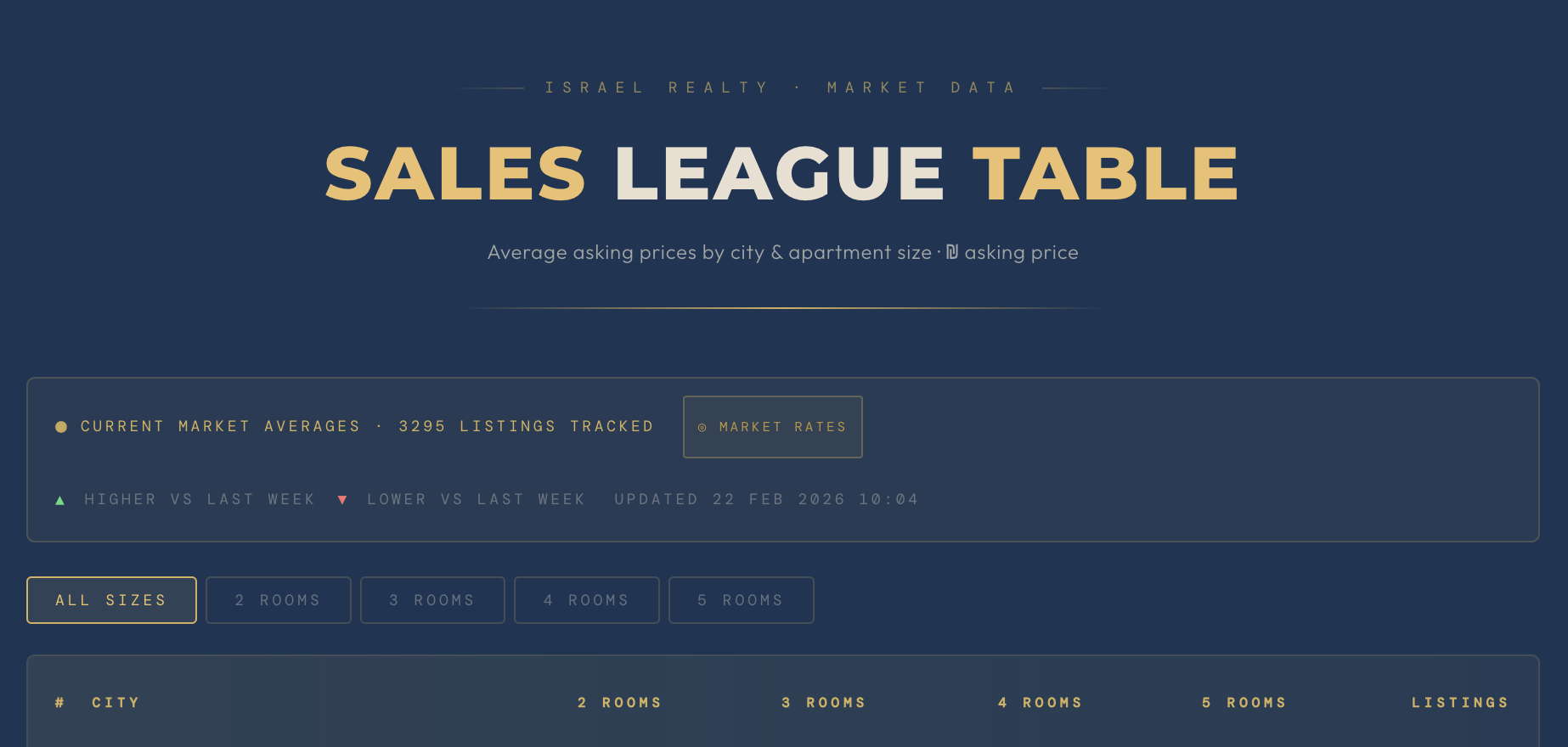
Buying an apartment in Israel is one of the most significant financial decisions most people will ever make — and navigating a market as diverse and fast-moving as Israel's requires more than intuition. It requires data. How do average asking prices compare between Tel Aviv and Netanya for the same size apartment? How much more does a 4-room property cost in Ra'anana compared to Ramat Beit Shemesh? And how have prices moved over the past week?
Our live Israel Property Sales League Table provides clear, comparative answers. Updated every 24 hours from current for-sale listings across 13 of Israel's most active property markets, the table ranks each city by average asking price across 2, 3, 4, and 5-room apartments — giving buyers, sellers, investors, and property professionals an accurate and up-to-date picture of where the Israeli property market stands right now.
All prices shown are average asking prices in Israeli Shekels (₪), displayed in millions (M) or thousands (K) for readability. Averages are calculated from current live listings with statistical outliers removed to reflect genuine market rates.
How to Read the Sales League Table
The table ranks cities from highest to lowest average asking price across all apartment sizes. You can filter by room count — 2, 3, 4, or 5 rooms — to compare cities specifically for the property type you are considering. Each cell shows the average asking price for that city and room count, a proportional price bar showing where it sits relative to the most expensive market in the table, and a trend indicator (▲ or ▼) showing price movement compared to the previous week's snapshot.
The listing count gives important context — cities with higher listing volumes provide more statistically robust averages. In smaller markets like Zichron Ya'akov, weekly averages can be more volatile because a single high-value listing entering or leaving the dataset has a proportionally larger effect on the mean.
City by City: Understanding the Sales Market Data
Tel Aviv — Israel's Most Expensive Property Market
Tel Aviv sits firmly at the top of the Israeli sales market, with average asking prices that reflect the city's global status, chronic undersupply, and relentless demand. Average 2-room apartments are currently listed at around ₪2.85M, 3-rooms at approximately ₪4.2M, 4-rooms at ₪6.5M, and 5-room properties averaging close to ₪9.8M. In premium neighbourhoods like Neve Tzedek, Rothschild Boulevard, and the Old North, prices for luxury properties frequently exceed ₪15M–₪20M and above.
Tel Aviv property has delivered extraordinary long-term capital appreciation and continues to attract buyers from Israel and internationally who see it as both a home and a store of value. Rental yields in Tel Aviv are lower than in other cities precisely because prices have risen so far — but for long-term capital growth, Tel Aviv's track record is unmatched in the Israeli market.
Herzliya — Prestige Pricing
Herzliya is Israel's second most expensive property market in our table, anchored by the extraordinary valuations in Herzliya Pituah — where seafront villas and luxury apartments regularly trade at ₪15M–₪25M and above. The table reflects a broader city average that includes more accessible properties in the city centre and Nof Yam area, bringing the 3-room average to around ₪3.6M and 4-rooms to approximately ₪5.8M. For investors, Herzliya's international appeal and consistently strong rental demand from the expatriate community make it a reliable long-term hold.
Jerusalem — Depth, History, and Diaspora Demand
Jerusalem occupies a unique position in the Israeli property market — a city where global Jewish diaspora demand for holiday apartments and pieds-à-terre creates a distinct buyer base that operates partially independently of the domestic Israeli market. Average 3-room properties in Jerusalem are currently listed at around ₪3.4M, with 4-rooms averaging ₪5.5M and 5-room properties approaching ₪8.4M. The best-located stone apartments in Rehavia, Talbiya, and the German Colony trade at significant premiums above these averages, reflecting both their scarcity and their enduring desirability.
Jerusalem's property market has shown consistent long-term resilience. Prices dipped briefly during periods of regional tension but have historically recovered and continued their upward trajectory. For buyers with a long time horizon, Jerusalem remains one of the most fundamentally sound markets in Israel.
Ra'anana — The Family Premium
Ra'anana's position near the top of the sales league table mirrors its ranking in the rental market — a reflection of the city's outstanding schools, well-maintained infrastructure, and deeply embedded status as the destination of choice for English-speaking families in the Sharon region. Average 3-room asking prices are around ₪3.1M, with 4-room family apartments averaging ₪4.9M. Properties in the most sought-after streets in Neve Zemer and the Anglo Quarter command premiums of 10–20% above these averages and compete intensely when they come to market.
Givat Shmuel — Strategic Location, Strong Value
Givat Shmuel's mid-table position in the sales league represents a genuine sweet spot in the Israeli property market — excellent connectivity to the Gush Dan region, consistent demand driven by Bar-Ilan University and surrounding employers, and prices that offer meaningful value relative to Tel Aviv and Herzliya. Average 3-room prices of around ₪2.9M and 4-rooms at approximately ₪4.6M make Givat Shmuel particularly attractive for investors seeking reliable rental yields from the student and academic market.
Ness Ziona — Southern Gush Dan's Rising Market
Ness Ziona has quietly become one of the most compelling property buying destinations in the southern Gush Dan area, with a well-developed urban environment, strong hi-tech employment base, and excellent schools supporting consistent demand. Average 3-room asking prices of around ₪2.8M and 4-room properties at ₪4.4M offer meaningful value relative to northern Gush Dan cities while delivering a comparable quality of life. The city's Science Park and growing life sciences sector are driving employment growth that will support property values over the medium term.
Modi'in — Affordable Quality Between the Major Cities
Modi'in's position in the table reflects its status as the most accessible entry point into Israel's premier family city market — modern apartments, outstanding schools, and a thriving community at prices noticeably below Ra'anana and other premium suburban destinations. Average 3-room prices of approximately ₪2.7M and 4-rooms at around ₪4.2M make Modi'in particularly popular with first-time buyers and young families making aliyah who want quality without the very highest price tier. Strong and consistent demand from this buyer demographic supports long-term value stability.
Netanya — Coastal Accessibility
Netanya offers one of the most compelling combinations in the Israeli property market: genuine Mediterranean coastline, a wide range of apartment types and neighbourhoods, and average asking prices that remain significantly below Tel Aviv and Herzliya. Average 3-room properties are currently listed at around ₪2.6M, with sea-view apartments in Agamim and Ir Yamim commanding premiums above this average and properties further from the sea offering more accessible entry points. For buyers seeking coastal lifestyle without coastal capital-city pricing, Netanya consistently delivers.
Be'er Ya'akov and Zichron Ya'akov — Value in Different Forms
Both cities sit in a similar price band in the table but offer very different propositions. Be'er Ya'akov's appeal is fundamentally about value and connectivity — well-priced apartments in a central location with its own train station and strong commuter demand that underpins both owner-occupier and buy-to-let interest. Zichron Ya'akov's appeal is about lifestyle — unique character, vineyard views, Mediterranean panoramas, and a boutique community that attracts buyers willing to pay a modest premium for something genuinely different. Average 3-room prices in both cities are around ₪2.4M.
Ramat Beit Shemesh — Community-Driven Growth
Ramat Beit Shemesh's position in the table reflects its status as a rapidly growing city with strong buyer demand from Anglo-Jewish and religious communities seeking affordable homeownership in a values-driven community setting. Average 3-room asking prices of approximately ₪2.3M and 4-room properties at around ₪3.6M represent genuine value by Israeli standards and remain accessible for first-time buyers and young families. Improved rail connections to Jerusalem and Tel Aviv have significantly enhanced the city's appeal as a commuter base, supporting continued price appreciation.
Ashkelon — Coastal Investment Value
Ashkelon offers the most affordable coastal property prices in our table, with 3-room apartments averaging around ₪1.9M and 4-rooms at approximately ₪2.9M. For investors, Ashkelon's combination of low entry prices, genuine Mediterranean beach access, and consistent rental demand from a large local population creates one of the more attractive yield opportunities in the Israeli market. As infrastructure investment continues and the city's reputation grows among buyers priced out of more expensive coastal cities, Ashkelon's long-term price trajectory remains positive.
Beer Sheva — Israel's Most Affordable Major City Market
Beer Sheva anchors the bottom of the sales league table with average asking prices that offer a genuinely transformative entry point into Israeli property ownership. 2-room apartments average around ₪850K — the only city in our table where a 2-room property can be purchased for under ₪1M — while 3-rooms average ₪1.3M and 4-room family apartments approximately ₪1.95M. For investors, these prices combined with the city's strong and growing rental market — driven by Ben-Gurion University, the booming cybersecurity sector, and increasing migration from central Israel — create a compelling yield and growth story that is attracting increasing attention from sophisticated buyers.
Understanding Price-to-Rent Ratios Across the Table
Cross-referencing the sales league table with the rental league table reveals important differences in price-to-rent ratios — a key metric for property investors evaluating which cities offer the best return on capital.
Tel Aviv's high sales prices relative to its rents produce lower gross yields than cities like Beer Sheva or Ashkelon, where entry prices are far lower but rental demand remains solid. An investor buying a ₪1.95M 4-room apartment in Beer Sheva and renting it for ₪5,900 per month is achieving a gross yield of approximately 3.6%, compared to a Tel Aviv investor buying a ₪6.5M 4-room and renting it for ₪13,800 — a gross yield of approximately 2.5%. The Beer Sheva investor achieves both higher yield and lower capital at risk, though Tel Aviv's superior capital appreciation track record means the comparison is not straightforward.
Gross yield is calculated as annual rent divided by purchase price. It does not account for management costs, vacant periods, mortgage costs, or capital gains — all of which significantly affect actual investment returns. Always consult a qualified financial adviser before making investment decisions.
Key Factors Driving Price Differences Between Cities
Land scarcity and planning constraints: Tel Aviv's inability to expand its physical footprint creates permanent upward pressure on prices that simply does not exist in cities like Beer Sheva or Ashkelon, which have abundant available land and building capacity.
Diaspora and international demand: Jerusalem and to a lesser extent Herzliya and Ra'anana benefit from sustained buying interest from the global Jewish diaspora — buyers who purchase for personal use, family visits, or cultural connection rather than pure investment logic. This demand is largely price-insensitive and provides a structural floor under prices in these markets.
Employment concentration: Israel's tech economy is heavily concentrated in a narrow corridor from Tel Aviv to Herzliya and up the coastal highway. Cities within commuting distance of this corridor — Givat Shmuel, Ra'anana, Ness Ziona, Modi'in — benefit directly from the high salaries and purchasing power of tech workers and their families.
Infrastructure investment trajectory: Beer Sheva, Ramat Beit Shemesh, and Be'er Ya'akov have all benefited meaningfully from improved rail connectivity in recent years. Cities that gain new or improved train connections to major employment centres typically see a sustained uplift in property values as commuting costs and times fall.
Community premium: The well-documented premium commanded by Ra'anana, Herzliya Pituah, and Ramat Beit Shemesh reflects the value buyers place on established communities with strong social infrastructure — schools, shuls, cultural institutions, and social networks — that reduce the friction of settling in a new city.
Tips for Buyers Using This Data
Use the table to identify your city tier: The sales league table quickly shows you which city tier your budget places you in. A buyer with ₪3M to spend faces a very different set of options than one with ₪6M — and the table makes those options immediately legible.
Compare the same room count across neighbouring cities: The most actionable insight from the table is often the price gap between neighbouring cities for identical room counts. A 4-room apartment in Be'er Ya'akov averages ₪3.9M versus ₪4.9M in Ra'anana — a ₪1M difference for cities that are 20 minutes apart by car.
Watch trends over multiple weeks: A single week's upward trend in a city's average does not mean prices are rising — it may simply reflect the composition of new listings entering the market. Monitor the table over four to eight weeks to identify genuine directional movement in your target city and room type.
Remember that averages are just the starting point: City-wide averages blend premium neighbourhoods with more affordable ones, new builds with older stock, and renovated properties with those needing work. The table tells you what to expect at the midpoint — your actual search will surface properties both above and below the average depending on location, condition, and specification.
How the Data Is Collected and Calculated
The sales league table draws live for-sale listing data from the Israeli property market, refreshed every 24 hours. For each city, all current for-sale listings are retrieved and filtered to exclude commercial properties and agency-exclusive premium listings. Prices are grouped by room count and averaged using a trimmed mean — removing the top and bottom 10% of prices to eliminate statistical outliers such as ultra-luxury penthouses or distress-sale properties that would otherwise distort the averages for typical buyers.
Week-on-week trend data is stored locally in your browser, enabling the table to display meaningful price movement comparisons without any server-side data collection. On first visit, trends will show as 'No prior data' — this will populate automatically after seven days as your browser builds a comparison baseline.
The Israeli property sales market moves quickly, and navigating it successfully requires both accurate data and experienced local knowledge. Whether you are a first-time buyer, an investor building a portfolio, or making aliyah and purchasing your family home, our team is here to guide you through every step of the process.
Whether you have questions about a specific city, want advice on the best neighbourhoods for your budget, or are ready to begin your property search, our team is here to help. Get in touch via our contact page and let's find the right property for you.
| # City | 2 Rooms | 3 Rooms | 4 Rooms | 5 Rooms | Listings |
|---|