Israel Rental Market League Table: Average Apartment Rents Across 13 Cities — Live Data
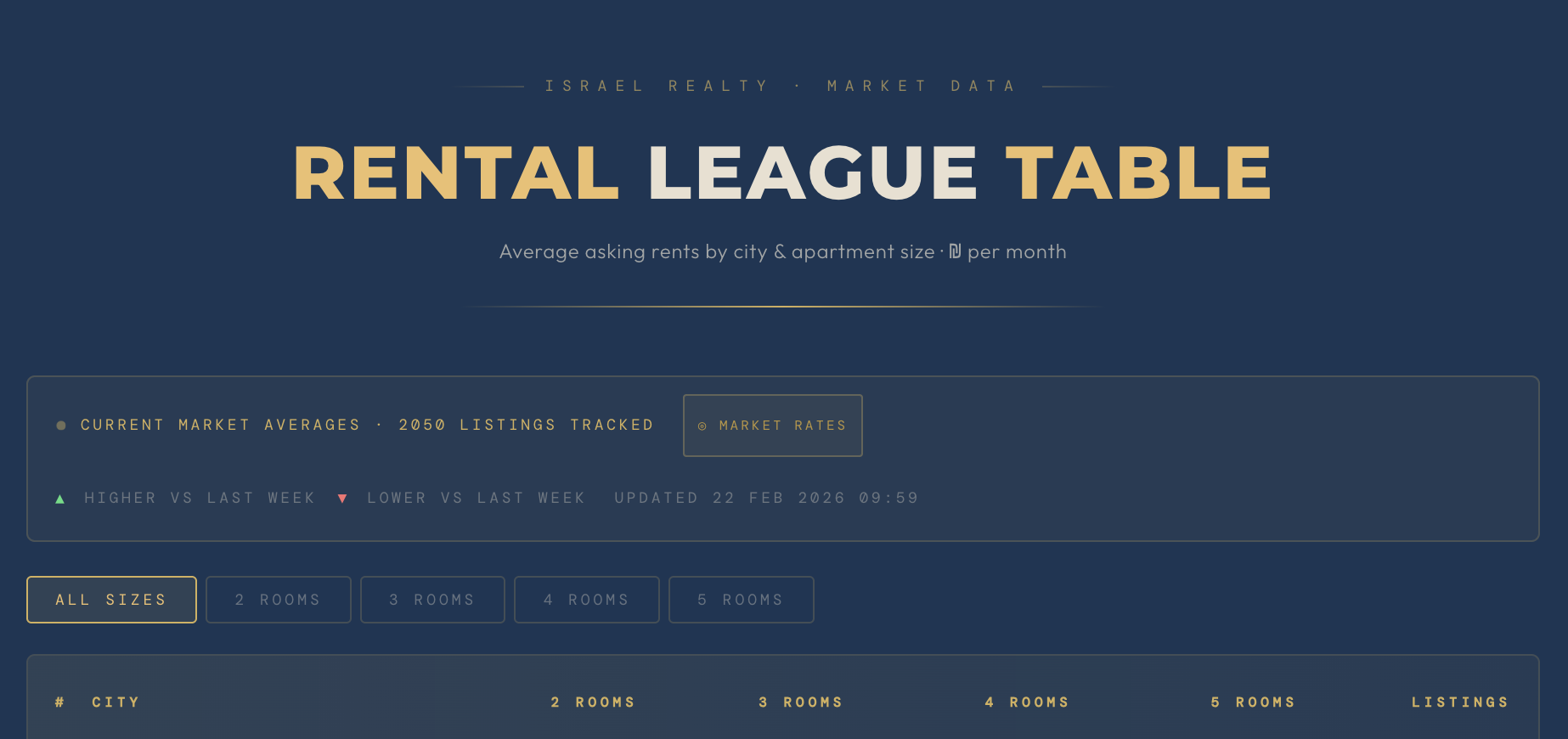
If you are searching for an apartment to rent in Israel, one of the most important questions you can ask is: how do rental prices compare between cities? Which cities offer the best value for a 3-room apartment? Where are 4-room rents most affordable for a growing family? And how have prices shifted over the past week?
Our live Israel Rental Market League Table answers all of these questions in one place. Updated every 24 hours with real asking prices drawn directly from current listings, the table ranks 13 of Israel's most popular cities by average monthly rent across 2, 3, 4, and 5-room apartments — giving renters, families making aliyah, investors, and property professionals a clear, comparative snapshot of the Israeli rental market as it stands today.
All prices shown are average asking rents in Israeli Shekels (₪) per month, calculated from current live listings. Outliers are trimmed from each dataset to ensure averages reflect genuine market rates rather than anomalous listings.
How to Read the Rental League Table
The table ranks cities from most to least expensive based on their overall average rent across all apartment sizes. You can filter the view by room count — 2, 3, 4, or 5 rooms — to see how each city ranks for the specific apartment type you are looking for. Each city row shows the average monthly rent for each room count, a relative price bar showing where that figure sits in the overall market, and a trend indicator (▲ or ▼) showing whether the average has risen or fallen compared to the snapshot taken seven days prior.
The listing count shown for each city gives you a sense of market depth — cities with more listings offer more choice and tend to have more statistically reliable averages. Cities with fewer listings may see averages fluctuate more week to week as individual properties enter and leave the market.
City by City: Understanding the Rental Market Data
Tel Aviv — Israel's Most Expensive Rental Market
Tel Aviv consistently ranks at the top of the Israeli rental market league table, and the data reflects the city's status as a global tech and culture hub with chronic housing undersupply. Average rents for 2-room apartments in Tel Aviv currently sit around ₪6,900 per month, rising to approximately ₪9,600 for 3-rooms, ₪13,800 for 4-rooms, and ₪19,500 or more for larger 5-room properties. Premium neighbourhoods like Neve Tzedek, Rothschild Boulevard, and the Old North command rents well above these averages.
For renters who want the Tel Aviv lifestyle without the Tel Aviv price tag, neighbouring cities like Givat Shmuel, Be'er Ya'akov, and Ness Ziona offer significantly more affordable options with fast commute times.
Herzliya — Premium Coastal Rents
Herzliya is the second most expensive rental market in our league table, driven by demand from the city's large expatriate community, proximity to major tech campuses along Route 4, and the premium status of Herzliya Pituah — one of Israel's most prestigious residential addresses. Average 3-room rents in Herzliya are around ₪8,400 per month, with larger family apartments ranging from ₪12,000 to ₪18,000 and above in the most desirable streets.
Ra'anana — The Anglo Community Premium
Ra'anana's position near the top of the table reflects its exceptional reputation as Israel's premier destination for English-speaking families. The combination of outstanding schools, beautiful parks, and a strong Anglo-Jewish community drives consistent rental demand that keeps prices elevated relative to other Sharon-region cities. Expect to pay around ₪7,900 per month for a 3-room apartment and ₪11,600 for a 4-room family home.
Jerusalem — Capital City Complexity
Jerusalem's rental market is unique in Israel — a city of enormous diversity where pricing varies dramatically by neighbourhood. The averages in our table reflect a broad market spanning student apartments near Hebrew University, diplomatic and NGO rentals in Rehavia and Talbiya, family homes in Baka and Katamon, and more affordable options further from the centre. Average 3-room rents sit around ₪7,500 per month, making Jerusalem more affordable than Tel Aviv and Herzliya on average while still commanding a significant premium over southern cities.
The Mid-Range Cities: Givat Shmuel, Ness Ziona, Modi'in, Netanya
These four cities cluster closely together in the middle of the table, each offering strong quality of life at more accessible prices than the top tier. Givat Shmuel's central Gush Dan location and Bar-Ilan University proximity keep demand high. Ness Ziona's thriving hi-tech sector and family-friendly infrastructure make it a consistent performer. Modi'in appeals strongly to families seeking modern housing at a central location between Tel Aviv and Jerusalem. Netanya offers the rare combination of Mediterranean beach access and mid-market pricing, making it particularly popular with French-speaking olim and coastal lifestyle buyers. In all four cities, 3-room apartments average between ₪6,600 and ₪7,000 per month.
Be'er Ya'akov — Central Israel's Best Value
Be'er Ya'akov punches well above its weight for renters seeking value in the centre of the country. With its own train station and direct highway access to Tel Aviv, Rishon LeZion, and Rehovot, the city offers genuine connectivity at prices noticeably below its neighbours. Average 3-room rents of around ₪6,000 per month make Be'er Ya'akov one of the most cost-effective rental options in the Gush Dan region.
Zichron Ya'akov and Ramat Beit Shemesh — Community and Character
Both cities occupy a similar price band in the table but serve very different renter profiles. Zichron Ya'akov attracts renters drawn by its wine-country setting, Carmel mountain views, and small-town atmosphere — an increasingly popular choice for remote workers and those seeking an alternative to urban living. Ramat Beit Shemesh is a primary destination for Anglo-Jewish and religious families, with strong community infrastructure and excellent schools driving consistent rental demand despite more modest pricing.
Ashkelon — Coastal Value
Ashkelon offers some of the most affordable rental prices among the coastal cities in our table, with 3-room apartments averaging around ₪5,100 per month. For renters willing to live slightly further from Tel Aviv, Ashkelon delivers genuine Mediterranean lifestyle — beaches, a growing city centre, and improving transport links — at a fraction of the cost of Herzliya or Netanya.
Beer Sheva — Israel's Most Affordable Major City
Beer Sheva anchors the bottom of the rental league table, and for good reason — it is Israel's fourth largest city and by far its most affordable for renters. With 2-room apartments averaging under ₪3,000 per month and 4-room properties around ₪5,900, Beer Sheva offers a cost of living that is genuinely transformative for budget-conscious renters, students at Ben-Gurion University, and young professionals entering the workforce. As the city's hi-tech and cybersecurity sectors continue to expand, rental demand is growing — and these prices may not stay this low indefinitely.
How to Use the Trend Data
The ▲ and ▼ trend indicators next to each average price show the direction and percentage change compared to the snapshot recorded seven days earlier. A ▲ 3% next to a city's 3-room average means that the average asking rent for 3-room apartments in that city has increased by 3% over the past week — which could reflect new high-priced listings entering the market, previously expensive listings being taken up, or genuine price movement.
Trend data should be interpreted as a directional signal rather than a precise measurement. A single week's movement does not constitute a trend. However, consistently upward movement over multiple weeks in a specific city and room type is a meaningful indicator of tightening supply and rising demand in that segment.
Trend indicators only appear after the first seven days of data collection. On your first visit, the table will display 'No prior data' in trend cells — this is normal and will populate automatically over the following week.
What Drives Rental Price Differences Between Israeli Cities?
Several structural factors explain the wide price range visible in our league table — from Tel Aviv's ₪13,800 average for 4-rooms to Beer Sheva's ₪5,900. Understanding these factors helps renters make more informed decisions about where to live and what to expect for their budget.
Proximity to employment centres: Cities closer to Tel Aviv's tech corridor and business districts command higher rents because they reduce commute time and cost. This is why Givat Shmuel and Herzliya rank higher than Ashkelon or Beer Sheva despite having smaller populations.
School quality and community infrastructure: Cities like Ra'anana and Modi'in carry a significant premium driven by exceptional school systems and community services. For families with children, this premium is often justified by the tangible difference in educational and social outcomes.
Supply constraints: Tel Aviv's inability to build outward — constrained by geography and planning regulations — keeps supply chronically below demand and prices consistently high. Cities like Beer Sheva and Ashkelon have far more available land and building capacity, keeping prices lower.
Community composition: Cities with large Anglo-Jewish or expatriate communities — Ra'anana, Herzliya, Ramat Beit Shemesh — tend to command higher prices in part because of the strong network effects and lifestyle infrastructure these communities create.
Transport connectivity: Direct train access to Tel Aviv is a meaningful price driver. Cities on the main Tel Aviv–Beer Sheva or Tel Aviv–Modi'in lines benefit from commuter demand that pushes rents above what might otherwise be expected for their location.
Tips for Renters Using This Data
The league table gives you a powerful comparative baseline, but translating averages into a successful rental search requires a few additional considerations.
Compare room counts across neighbouring cities: If your budget for a 4-room apartment in Ra'anana is stretched, the data shows that Givat Shmuel, Ness Ziona, or Modi'in offer comparable quality of life at meaningfully lower average rents for the same room count.
Watch the trend data over time: If you see a consistent upward trend in your target city and room type over several weeks, that is a signal to act sooner rather than later. Rising averages in a specific segment indicate tightening supply.
Understand that averages mask neighbourhoods: A city-wide average will always blend premium neighbourhoods with more affordable ones. Within Tel Aviv, the gap between Neve Tzedek and Jaffa for the same room count can be ₪3,000–₪5,000 per month. Use the table to identify your target city, then research specific neighbourhoods within it.
Factor in total cost of living: A lower rent in Beer Sheva or Ashkelon may be partially offset by higher transport costs if you are commuting to Tel Aviv. Factor in monthly train passes, fuel costs, and time when comparing the true cost of living in different cities.
How the Data Is Collected and Calculated
The rental league table draws live listing data from the Israeli property market, updated every 24 hours. For each city, all current rental listings are retrieved and filtered to remove commercial properties and agency-exclusive premium listings that do not reflect standard market rates. Prices are then grouped by room count and averaged, with the top and bottom 10% of prices trimmed from each group to remove statistical outliers — unusually expensive penthouses or unusually cheap properties that would distort the true average for typical renters.
The result is a trimmed mean that accurately represents what a renter should expect to pay for a typical apartment in each city and room count combination. The table refreshes automatically every 24 hours, and trend data is saved locally to your browser to enable week-on-week comparison without any server-side storage.
Ready to start your rental search in Israel? Whether you are relocating for work, making aliyah, or simply looking for your next home, our team has deep expertise across all 13 cities in this table.
Whether you have questions about a specific city, want advice on the best neighbourhoods for your budget, or are ready to begin your property search, our team is here to help. Contact us today and let's find the right property for you.
| # City | 2 Rooms | 3 Rooms | 4 Rooms | 5 Rooms | Listings |
|---|